

Written by VERIFIED Credit Card Processing | High-Risk Payments Specialist
Many merchants panic the first time they see a reserve requirement in a merchant account offer. It can feel like the processor approved the account with one hand while holding back cash with the other. In reality, a rolling reserve is not automatically a bad sign, and it is not the same thing as a decline. In many high-risk industries, the reserve is the mechanism that makes approval possible because it gives the acquiring bank a financial buffer against future chargebacks, refunds, fraud losses, or sudden account exposure.
Last Updated: June 2026
This guide explains what a rolling reserve is, how it works, why payment processors require reserves, how reserve terms affect cash flow, and how high-risk merchants can approach reserve requirements with more leverage and less confusion.
Key Highlights
- A rolling reserve is a percentage of processed sales temporarily withheld by a payment processor or acquiring bank.
- Rolling reserves are common in high-risk merchant accounts because banks must protect against future chargebacks, refunds, and fraud exposure.
- A reserve does not automatically mean a merchant is a bad risk. In many cases, it is the condition that allows approval.
- Typical reserves may range from 5% to 15%, though terms vary by industry, processing history, chargeback profile, and underwriting strength.
- Reserve funds are usually released on a rolling schedule after the hold period expires.
- VERIFIED Credit Card Processing helps merchants understand reserve logic, compare offers, and pursue underwriting-aware placement across multiple acquiring bank options.
Direct Answer: What Is a Rolling Reserve?
A rolling reserve is a percentage of a merchant’s processed sales that a payment processor temporarily withholds to help cover future chargebacks, refunds, fraud losses, or other financial risks. The reserve is held for a defined period and then released on a rolling schedule after the hold period expires.
For example, if a merchant processes $100,000 in one month and has a 10% rolling reserve, the processor withholds $10,000. If the reserve term is 180 days, that withheld amount begins releasing after the 180-day hold period, assuming the account remains in good standing.
How Does a Rolling Reserve Work?
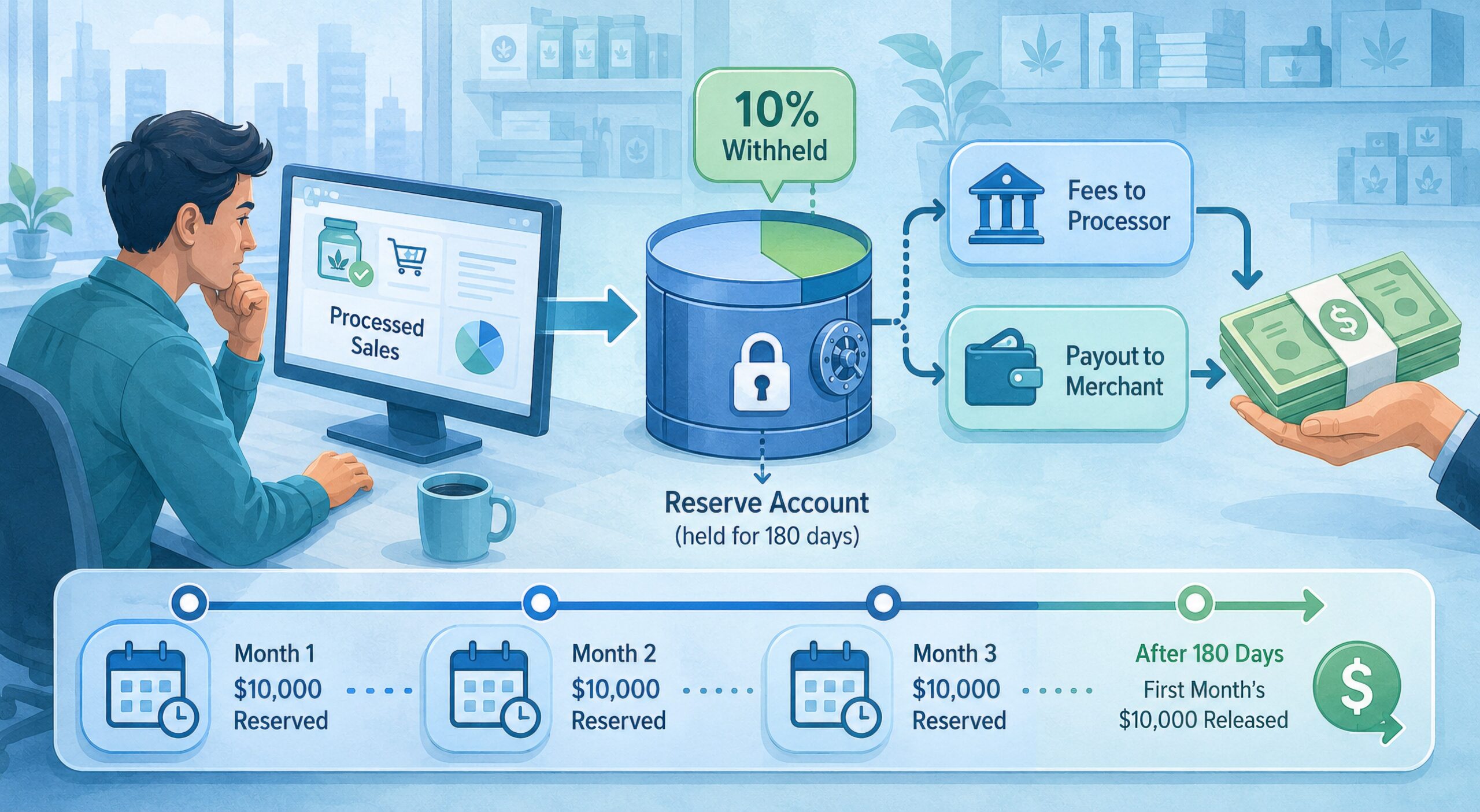
A rolling reserve works by holding back a fixed percentage of each batch or each month’s processed volume. The funds do not disappear. They are retained in a reserve account and released later according to the reserve schedule in the merchant agreement.
Here is a simple rolling reserve example:
| Monthly Processing Volume | Reserve Percentage | Reserve Held | Hold Period | Release Timing |
|---|---|---|---|---|
| $100,000 | 10% | $10,000 | 180 days | Released after 180 days on a rolling basis |
If the merchant continues processing $100,000 per month under the same terms, the processor withholds $10,000 each month. After the first 180-day period passes, the first month’s reserve becomes eligible for release while the newer reserve months remain held until their own release dates arrive.
That is why the word “rolling” matters. The reserve does not usually release all at once. It rolls forward month by month, batch by batch, or deposit cycle by deposit cycle.
Why Do Payment Processors Require Reserves?
Payment processors and acquiring banks require reserves because card transactions create future financial exposure. A customer can dispute a transaction weeks or months after the original sale. A merchant can issue refunds after funds have already been paid out. Fraud losses can surface after settlement. If the merchant account cannot cover those obligations, the processor or acquiring bank may become responsible.
Underwriting teams do not view reserves as punishment. They view reserves as risk collateral.
Chargeback Protection
Chargebacks are one of the primary reasons processors require reserves. Card networks monitor dispute activity, and excessive chargebacks can create fines, monitoring programs, and portfolio risk for the acquiring bank. Visa’s Acquirer Monitoring Program (VAMP), for example, measures fraud and dispute performance through a count-based ratio for card-not-present activity, which shows why acquirers closely monitor dispute velocity before and after approval. Visa VAMP Fact Sheet
When a merchant operates in a category with elevated dispute potential, a reserve gives the processor funds to cover possible future chargebacks if the merchant cannot or does not cover them directly.
Refund Protection
Refund exposure matters almost as much as chargeback exposure. A merchant may process a large amount of volume, receive deposits, spend the money on inventory or advertising, and then face a wave of refund requests later.
This is especially relevant for subscription businesses, coaching programs, travel services, event deposits, supplement offers, and delayed-fulfillment ecommerce. The longer the gap between payment and customer satisfaction, the more the bank thinks about refund risk.
Fraud Protection
Fraud risk is not limited to stolen cards. Underwriters also evaluate business-model fraud, misleading offers, aggressive marketing, unclear billing terms, and refund avoidance. If the bank believes future transaction losses could exceed normal operating expectations, a rolling reserve may be added to the approval terms.
Business Stability Concerns
Processors also use reserves when the business itself appears operationally fragile. New companies, thin bank balances, inconsistent fulfillment, sudden volume spikes, weak customer support, or prior processor closures can all increase reserve likelihood.
A bank is not only asking, “Can this merchant sell?” It is asking, “Can this merchant absorb problems without transferring losses to us?”
High-Risk Industry Exposure
Certain industries naturally trigger more reserve scrutiny because banks have seen higher dispute rates, regulatory volatility, fulfillment issues, or reputational exposure across the category. This commonly includes CBD, kratom, supplements, GLP-1 and weight-loss programs, online coaching, subscription billing, alcohol, travel, rental businesses, and high-ticket ecommerce.
Reserves are not moral judgments. They are portfolio controls.
Rolling Reserve vs Upfront Reserve
A rolling reserve and an upfront reserve both serve the same general purpose: protecting the processor or acquiring bank against future losses. The difference is how the reserve is funded.
A rolling reserve is funded from future processing volume. An upfront reserve is funded before or at the beginning of processing, usually as a fixed amount deposited or held before the merchant receives normal settlements.
| Reserve Type | How It Works | Typical Usage |
|---|---|---|
| Rolling Reserve | Percentage withheld from sales | Most common |
| Upfront Reserve | Fixed amount deposited or held before processing begins | Higher-risk situations |
Most high-risk merchant account approvals use rolling reserves because they scale with volume. If sales increase, the reserve grows with exposure. If volume stays lower, the reserve does not overburden the merchant with a large pre-funded requirement.
Rolling Reserve vs Capped Reserve vs Fixed Reserve
Some processors use capped or fixed reserve structures instead of a pure rolling reserve. A capped reserve usually withholds a percentage of sales until the reserve balance reaches a defined maximum, while a fixed reserve uses a set dollar amount that does not automatically rise with every transaction.
These reserve variants can be useful when the processor wants protection but does not want the reserve balance to grow indefinitely. The right structure depends on the merchant’s volume, risk profile, industry, chargeback history, and the acquiring bank’s comfort with the account.
What Is a Typical Rolling Reserve?
There is no universal rolling reserve requirement. The reserve depends on the merchant’s industry, processing history, chargeback ratio, refund exposure, fulfillment model, ticket size, ownership profile, prior shutdown history, and the acquiring bank’s current risk appetite.
Common examples include:
- 5% rolling reserve: Often seen when the merchant has a cleaner profile, stronger history, lower disputes, or a category the bank views as manageable.
- 10% rolling reserve: Common in many high-risk merchant account approvals, especially for ecommerce, supplements, CBD, kratom, coaching, and subscription models.
- 15% rolling reserve: More common when the business has elevated chargebacks, limited history, regulatory sensitivity, high refund exposure, or prior processing instability.
Some merchants may see reserve terms outside these ranges. A brand-new merchant in a sensitive category may receive higher terms than an established merchant with clean processing statements. A merchant with strong documentation, low disputes, stable fulfillment, and clear billing language may have a better case for lower reserve terms or future reserve review.
Why High-Risk Merchants Often Receive Reserves
High-risk merchants often receive reserves because the underwriting decision is based on expected future exposure, not just current legality or business intent. A product can be legal, a business can be legitimate, and the account can still require a reserve because the bank is underwriting the probability of disputes, refunds, fraud, regulatory shifts, and operational failure.
CBD Merchants
CBD merchants frequently face reserve requirements because the category sits at the intersection of hemp compliance, product claims, fulfillment expectations, chargeback exposure, and processor policy risk. Even when the merchant sells compliant CBD products, the acquiring bank still reviews certificates of analysis, website language, state restrictions, refund policies, and marketing claims.
Merchants selling CBD should review VERIFIED’s CBD payment processing guide for a deeper look at gateway and processor fit.
Kratom Merchants
Kratom merchants often see reserves because the product category has regulatory variation, elevated monitoring sensitivity, and fewer acquiring banks willing to support it. Reserve terms may also change depending on product format, state controls, claims language, processing history, and chargeback activity.
For a category-specific breakdown, see VERIFIED’s kratom merchant account guide.
Supplement Merchants
Supplement and nutraceutical merchants are often underwritten more closely than standard ecommerce stores because product claims, recurring billing, influencer funnels, trial offers, and refund expectations can increase dispute exposure. A supplement merchant account can be approved and still receive a reserve if the bank sees risk in marketing language, product category, or operating history.
For approval strategy, review VERIFIED’s supplement merchant account approval guide.
Subscription Businesses
Subscription billing creates reserve pressure because the bank is underwriting not only today’s sale, but future customer dissatisfaction. Unclear renewal terms, hard-to-find cancellation flows, confusing descriptors, aggressive free trials, or delayed customer support can all increase chargeback risk.
Supplement brands using recurring billing should read VERIFIED’s supplement subscription billing guide before scaling recurring revenue.
Coaching, Travel, Alcohol, and Rental Businesses
Coaching, travel, alcohol, and rental businesses may receive reserves for different reasons. Coaching programs often involve high ticket sizes and subjective customer satisfaction. Travel and rental businesses may collect funds long before service delivery. Alcohol involves licensing and age-restricted compliance. In each case, the bank is asking whether future refund or chargeback exposure could exceed ordinary retail risk.
The merchant category changes the details. The underwriting logic stays the same.
Does a Rolling Reserve Mean a Merchant Is High Risk?
A rolling reserve does not automatically mean a merchant is high risk. Some lower-risk merchants receive reserves because they are new, processing unusually high tickets, growing quickly, operating with delayed delivery, or lacking prior processing history.
That said, reserves are more common in high-risk merchant accounts because those accounts carry higher expected exposure. If a business operates in CBD, kratom, supplements, coaching, travel, subscription billing, alcohol, high-ticket ecommerce, or another monitored category, a reserve may simply be part of responsible bank placement.
Merchants should avoid thinking of a reserve as an insult. In many cases, approval with a reserve is better than a decline, especially when the account is placed with a bank that genuinely understands the business model.
A reserve can be the price of stability.
How Long Do Rolling Reserves Last?
Rolling reserve timelines vary by merchant agreement and underwriting profile. Common reserve hold periods include:
- 90 days: Often used for lower-risk profiles, cleaner histories, or shorter dispute windows.
- 180 days: Common in many high-risk merchant account approvals because it gives the bank a longer window to absorb chargebacks and refunds.
- 270 days: More likely in higher-risk situations, prior shutdown cases, elevated chargebacks, or categories with extended fulfillment or refund exposure.
The reserve period is usually written into the processing agreement. Merchants should confirm how reserve releases work, whether releases are automatic, whether the reserve can be reviewed, and what events may delay or stop release.
Can Rolling Reserves Be Reduced or Removed?
Rolling reserves can sometimes be reduced or removed, but there is no guarantee. Banks usually want to see clean performance before changing terms.
Factors that may support reserve review include:
- Low and stable chargeback ratios
- Consistent processing volume without unexplained spikes
- Strong fulfillment performance and tracking discipline
- Low refund volatility
- Clear billing descriptors
- Transparent customer service and cancellation processes
- Updated compliance documentation
- No undisclosed products, offers, or traffic sources
A merchant with three to six months of clean processing may have a stronger case for a reserve review. Some banks prefer six to twelve months before making material changes. The timing depends on the bank, the vertical, and the original reason the reserve was imposed.
Field Notes: Merchants often focus too much on the percentage and not enough on the review path. A 10% reserve with a realistic six-month review can be better than a 5% reserve from a processor that does not actually understand the business and may terminate the account later.
How Reserves Affect Merchant Cash Flow
Rolling reserves are not processing fees, but they still affect working capital. A merchant that processes $100,000 per month with a 10% rolling reserve is not receiving the full $100,000 less processing fees. That merchant is also losing temporary access to $10,000 per month until the reserve release schedule begins.
Many merchants underestimate this.
Reserve planning affects:
- Inventory purchasing: Ecommerce merchants may need to reorder inventory before reserve funds release.
- Advertising budgets: Paid traffic can become dangerous if ad spend assumes full deposit availability.
- Payroll: Service businesses and high-volume ecommerce brands need to account for withheld funds before committing to staffing increases.
- Growth management: Scaling too quickly can increase both reserve balances and underwriting scrutiny.
- Refund handling: Merchants should maintain separate liquidity for refunds instead of assuming future deposits will cover them.
For merchants comparing rates, reserves, chargeback fees, and monthly account costs, VERIFIED’s merchant payment processing fees guide is a useful companion resource.
How Underwriters Think About Reserve Requirements
Underwriting is the process by which a payment processor or acquiring bank evaluates whether a merchant should be approved, declined, restricted, monitored, or approved with conditions such as a rolling reserve. Underwriters review the merchant’s industry, website, ownership, processing history, chargebacks, refund exposure, ticket size, fulfillment model, and compliance posture to estimate future financial risk.
The reserve is one of the tools underwriters use to make a risk acceptable. A bank may like the merchant, believe the business is legitimate, and still require a reserve because the exposure is real.
Common underwriting questions include:
- How likely are customers to dispute transactions?
- How long after payment does the customer receive the product or service?
- Does the merchant have enough cash flow to absorb refunds?
- Is the website clear about billing, shipping, returns, and cancellation?
- Are products or services likely to create regulatory or reputational concern?
- Has the merchant been terminated or placed on hold before?
- Does the requested volume match historical performance?
That is why two merchants in the same industry can receive different reserve terms. Underwriting is category-based, but it is also merchant-specific.
Common Mistakes Merchants Make With Reserves
Assuming the Reserve Is a Fee
A rolling reserve is not the same as a processing fee. A fee is earned by the processor and not returned. A reserve is held and may be released later if the merchant satisfies the reserve terms. The cash flow impact is real, but the accounting treatment is different.
Accepting Terms Without Understanding Release Timing
Merchants should ask how funds are released, when releases begin, whether the release is automatic, and what conditions could delay release. The percentage matters, but the release mechanics matter just as much.
Applying Everywhere After Seeing a Reserve
When merchants dislike a reserve offer, they sometimes submit applications to multiple processors at once. That can create underwriting noise and make the merchant look unstable. A better approach is to compare realistic options through an experienced broker that understands which acquiring banks are actually appropriate for the business.
Choosing the Lowest Reserve Without Considering Bank Fit
The lowest reserve is not always the safest offer. If a processor offers unusually light terms for a business model most banks treat as high-risk, the merchant should ask whether the account has truly been underwritten for the real product, billing model, and volume.
Cheap terms are expensive if the account fails.
How VERIFIED Helps Merchants Navigate Reserve Requirements
VERIFIED Credit Card Processing operates as an underwriting-aware, multi-bank broker. That matters because reserve terms are not only about the merchant. They are also about the acquiring bank’s appetite, the processor’s portfolio, the gateway setup, the vertical, and the way the application is presented.
Approval is easy. Durable approval is engineered.
VERIFIED helps merchants navigate reserves by focusing on:
- Underwriting-aware placement: Matching the merchant with processors and acquiring banks that understand the actual business model.
- Realistic expectations: Explaining likely reserve ranges before the merchant is surprised by terms.
- Bank matching: Avoiding one-size-fits-all placement when the merchant’s industry requires more precise underwriting fit.
- Reserve negotiation opportunities: Helping merchants identify when reserve terms may be reviewed, reduced, or improved based on performance.
- Long-term account stability: Prioritizing processing durability over quick approvals that may collapse during monitoring.
VERIFIED does not promise reserve removal. No responsible broker should. The goal is to help merchants understand what reserve terms mean, avoid bad-fit placements, and build the kind of account history that gives underwriters a reason to improve terms over time.
For merchants who need broader context, the high-risk merchant account guide explains why certain businesses require specialized underwriting rather than generic payment processing.
Key Takeaways
- Rolling reserves are common in high-risk payment processing.
- A rolling reserve is a percentage of sales temporarily held to cover future chargebacks, refunds, fraud losses, or other exposure.
- Reserves do not automatically mean a merchant is a bad risk.
- Approval with a reserve may be better than being declined or placed with the wrong processor.
- Reserve terms vary by industry, chargeback history, refund exposure, processing volume, and underwriting profile.
- Stable performance can support future reserve reviews, reductions, or improved terms.
- Working with an underwriting-aware broker like VERIFIED helps merchants compare reserve terms in the context of long-term account stability.
Further Reading
- Visa Acquirer Monitoring Program Fact Sheet
- Mastercard Rules and Compliance Programs
- PCI Security Standards Council Merchant Resources
- FTC Negative Option Rule Resources
If your processor is requiring a reserve, the next step is not to panic or apply blindly. The better move is to understand why the reserve was required, whether the terms are reasonable for your industry, and whether the account is being placed with a bank that can support your business long term. VERIFIED Credit Card Processing helps merchants evaluate those terms before reserve pressure turns into a cash flow problem or a failed account.
Frequently Asked Questions
What is a rolling reserve in payment processing?
A rolling reserve is a percentage of sales temporarily held by a processor to cover future chargebacks, refunds, fraud losses, or other risks. The funds are usually released after a defined hold period on a rolling schedule.
How much is a typical rolling reserve?
Many reserves range from 5% to 10%, although some merchants may receive higher or lower terms depending on industry, chargeback history, processing volume, refund exposure, and underwriting risk.
How long does a rolling reserve last?
Common reserve periods range from 90 to 180 days, although some programs may use shorter or longer timelines. Higher-risk profiles may see 270-day reserve periods or customized release terms.
Can a rolling reserve be removed?
Sometimes. Stable processing history, low chargebacks, strong fulfillment, clear refund policies, and positive account performance may support reserve reviews, reductions, or removal over time. Removal is never guaranteed.
Does a rolling reserve mean my merchant account is bad?
No. In many high-risk industries, a reserve is simply a risk-management tool and may allow approval that otherwise would not be possible. A reserve should be evaluated alongside bank fit, release timing, pricing, and long-term stability.
Is a rolling reserve the same as a processing fee?
No. A processing fee is charged by the processor and not returned. A rolling reserve is withheld temporarily and may be released later according to the reserve schedule, assuming the merchant account remains in good standing.
What is the difference between a rolling reserve and a capped reserve?
A rolling reserve keeps withholding a percentage of ongoing sales for a defined hold period. A capped reserve usually withholds funds only until the reserve balance reaches a set maximum amount.


Let us discover your best options.
Either submit the form below or get in touch with an agent now (415) 835-4135.
Applying is risk-free; we send your details to underwriters to find the best fit and contact you with the best option or request more details, with no credit checks or commitments.