

Written by VERIFIED Credit Card Processing | High-Risk Payments Specialist
Supplement subscription billing can turn a one-time buyer into predictable recurring revenue, but it also changes how processors and acquiring banks evaluate the business. A merchant that looks stable on standard ecommerce sales can become a higher-risk account once rebills, cancellation expectations, refund patterns, and customer disputes start accumulating. Many supplement merchants are approved at first, then later run into reserves, monitoring, funding delays, payout holds, or full merchant account shutdowns because the subscription model was never underwritten correctly from the beginning.
Last Updated: May 2026
Key Highlights
- Supplement subscription billing receives closer underwriting scrutiny because rebills create more dispute exposure than one-time purchases.
- Clear billing terms, cancellation access, customer support, and fulfillment consistency directly affect account stability.
- Chargebacks matter, but banks also evaluate refund trends, claims language, traffic sources, growth velocity, and customer complaint patterns.
- A supplement merchant account can be approved and still be unstable if the acquiring bank does not support the merchant’s recurring billing profile.
- VERIFIED helps subscription supplement merchants by matching the business to compatible high-risk acquiring options rather than treating approval as the finish line.
Direct Answer: Why Does Subscription Billing Create More Payment Risk?
Supplement subscription billing is a recurring payment model where customers are charged automatically for supplement orders on a scheduled basis, usually monthly or at another agreed interval. It creates more payment risk because each rebill gives the customer another opportunity to dispute, forget the purchase, misunderstand the renewal terms, or object to the cancellation process.
Processors often view recurring supplement payments as higher risk because:
- Recurring transactions generate more dispute opportunities over time.
- Customer expectations are harder to manage after the initial sale.
- Cancellation confusion often turns into chargebacks.
- Continuity billing has a long history of abuse in health, wellness, and nutraceutical categories.
- Poor communication makes banks question whether future dispute exposure is under control.
Recurring revenue is attractive. Recurring risk compounds.
Why Supplement Subscription Businesses Face Higher Underwriting Scrutiny
Subscription billing is not automatically a problem. The risk comes from the combination of health-related products, recurring transactions, claims-sensitive marketing, and customer expectation management. That combination gives underwriters more to evaluate than they would with a standard single-purchase ecommerce store.
Recurring Billing Increases Dispute Exposure
A one-time supplement order creates one transaction. A subscription relationship may create six, twelve, or more transactions from the same customer. Each renewal adds more exposure to forgotten billing, product dissatisfaction, shipping issues, descriptor confusion, or cancellation disputes.
Many chargebacks in subscription supplement businesses are not traditional fraud. They are often customer-confusion disputes. The customer may recognize the brand but still dispute because they forgot the renewal, thought the subscription was cancelled, expected a reminder, or believed the original purchase was a one-time order.
Continuity Models Create Processor Concern
Continuity billing refers to a model where the customer is enrolled into ongoing shipments or recurring charges after an initial purchase, trial, or promotional offer. In supplement processing, continuity models are reviewed closely because the category has a history of unclear trial offers, aggressive claims, difficult cancellation paths, and rebill complaints.
Acquiring banks monitor these models because customer confusion today becomes chargeback liability later. When a bank sponsors a merchant account, it is not only approving the merchant’s current volume. It is accepting future exposure from disputes, refunds, network monitoring, and reputational risk.
Underwriting does not just ask, “Can this merchant sell supplements?” It asks, “Will this billing model create future liability?”
Long Customer Lifetime Creates More Payment Risk
Subscription merchants often focus on lifetime value, but processors focus on lifetime exposure. A high-retention supplement customer may be profitable for the merchant, but from the bank’s perspective, every rebill increases the number of transactions that could later become disputes.
That does not make subscriptions bad. It means the account must be structured correctly. Merchants pursuing supplement merchant account approval need to present the recurring model clearly during underwriting, not hide it until volume begins scaling.
The Most Common Reasons Supplement Subscription Accounts Get Shut Down
Subscription supplement accounts are usually shut down after a pattern forms. The merchant may see isolated symptoms — a few more refunds, a few more complaints, a delayed batch — while the processor sees a broader risk trend.
Rising Chargeback Ratios
Chargebacks remain the most obvious shutdown trigger. When disputes rise, banks start asking whether the issue is fraud, unclear billing, bad traffic, delayed fulfillment, misleading product claims, or weak customer support. Subscription businesses are especially vulnerable because small disclosure problems can repeat across every rebill cycle.
One bad funnel can create hundreds of future disputes. Chargeback alerts are a necessity for a subscription based business.
Weak Cancellation Process
A difficult cancellation process is one of the fastest ways to damage a recurring billing account. If customers cannot cancel easily, they often bypass support and contact their card issuer. From the processor’s perspective, that signals operational weakness, not just customer frustration.
Cancellation friction may feel like retention in the short term. In underwriting, it looks like future dispute pressure.
Poor Recurring Billing Disclosures
Underwriters look for clear recurring terms before the customer is charged. Weak disclosures include small-font renewal terms, vague “autoship” language, unclear billing frequency, missing cancellation instructions, or a checkout flow that does not make the subscription obvious.
Supplement subscription payment processing becomes more stable when the customer understands the renewal before the first transaction happens. The cleaner the consent trail, the easier it is to defend the account if disputes arise.
Aggressive Claims Language
Claims risk does not disappear because billing is the topic. In supplements, product claims and recurring billing often collide. If a merchant uses aggressive weight loss, testosterone, sexual wellness, cognitive enhancement, disease, or guaranteed-result claims, banks may view recurring billing complaints as part of a larger compliance problem.
This is why nutraceutical payment processing compliance matters before a subscription funnel is launched. Marketing language, checkout disclosures, refund policies, and billing descriptors all affect account survival.
Sudden Growth Spikes
Subscription brands can scale quickly through paid media, influencer traffic, affiliate campaigns, and trial offers. That growth may look positive from a sales perspective, but sudden volume spikes can trigger review if the bank was not expecting the increase.
Growth without underwriting alignment often becomes a reserve conversation.
High Refund Activity
Refunds are better than chargebacks, but elevated refund activity still tells a story. A high refund rate may indicate product dissatisfaction, unclear terms, delayed shipping, aggressive retention scripts, or mismatch between marketing promises and customer experience.
Processors evaluate refunds because they are often the warning light before supplement chargebacks accelerate.
Warning Signs Your Subscription Business Is Being Reviewed
Most merchant account reviews begin quietly. The account may still process transactions, but the processor starts adjusting risk controls or asking for more information.
Reserve Increases
A rolling reserve or reserve increase means the bank wants more protection against future chargebacks, refunds, and settlement exposure. For subscription supplement merchants, reserve increases often follow rising dispute ratios, faster volume growth, refund spikes, or changes in product mix.
Funding Delays
If payouts slow down, batches are held, or deposits start arriving later than usual, the processor may be reviewing recent transactions before releasing funds. Funding delays are not always a shutdown signal, but they should never be ignored.
Additional Document Requests
Requests for updated processing statements, product labels, supplier documents, fulfillment records, marketing examples, cancellation policies, or website screenshots usually mean underwriting is reassessing the account.
Monthly Volume Restrictions
Volume caps are often used when the processor is not comfortable with the current growth rate. Subscription merchants may see caps imposed after a campaign performs well, especially if the original application projected lower volume.
Increased Fraud Monitoring
More fraud rules, stricter gateway filters, higher decline rates, or additional transaction review can indicate that the processor is trying to reduce exposure before deciding whether the account remains supportable.
How Banks Evaluate Subscription Supplement Merchants
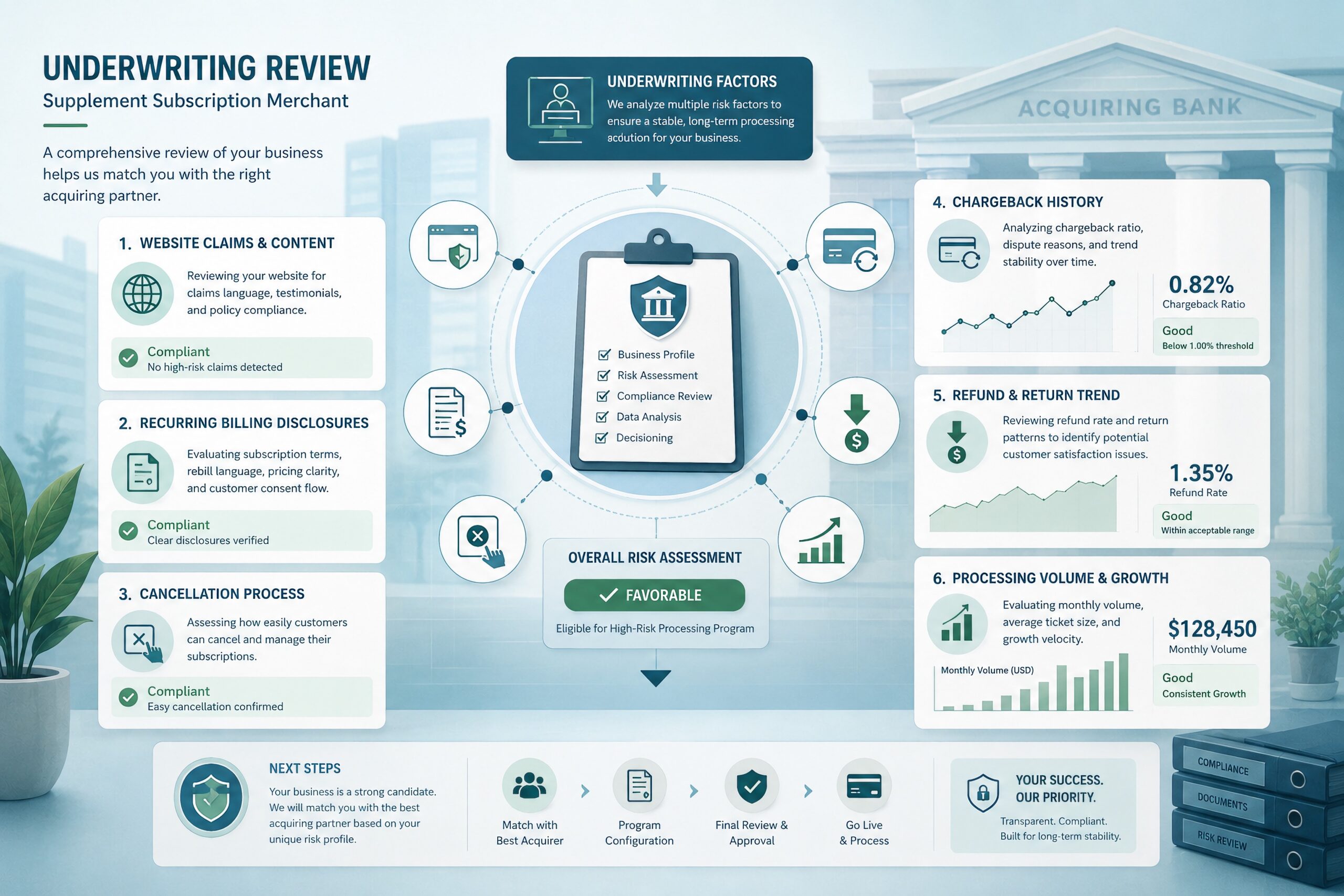
Acquiring banks evaluate subscription supplement merchants as operating systems, not just websites. They look at the entire customer journey: advertising, product page, checkout, consent, billing descriptor, fulfillment, support, cancellation, refund handling, and dispute response.
As of the 2025–2026 regulatory landscape, automatic renewal, negative option, and subscription cancellation practices are receiving closer attention from regulators, card networks, and acquiring banks. That matters for supplement merchants because unclear continuity billing is no longer treated as a minor disclosure issue. It is evaluated as a payment-risk signal that can affect reserves, monitoring, and account durability.
Subscription Transparency
Underwriters want to know whether the customer clearly understands they are enrolling in recurring billing. This includes the renewal frequency, amount, cancellation method, and what happens after any trial or promotional period.
Billing Clarity
Billing descriptors matter. If the charge on the customer’s statement does not clearly connect to the brand or product purchased, disputes rise. A confused customer often calls the bank before contacting the merchant.
Cancellation Process
Cancellation should be easy to find, easy to use, and documented. The more effort required to cancel, the more likely the customer is to dispute. Banks know this and evaluate cancellation flow as part of recurring billing risk.
Customer Support
Fast support lowers chargebacks. Slow support increases them. Processors care about response windows, support channels, refund handling, and whether customers can resolve billing issues without involving their card issuer.
Processing History
Clean processing history is one of the strongest approval assets. Banks look at monthly volume, average ticket, refund rate, chargeback ratio, prior terminations, reserve history, and whether past processors raised concerns.
Dispute Trends
Underwriters do not only evaluate the current chargeback number. They look at velocity. A merchant moving from 0.35% to 0.70% over a short period may be treated more cautiously than a merchant sitting at a stable, well-explained level.
For merchants selling supplements, a supplement payment processing setup needs to be matched to the actual billing model, not just the product category.
How Supplement Merchants Reduce Subscription Payment Risk
Subscription risk is manageable when the merchant treats billing clarity as part of payment infrastructure. The goal is not merely to get the subscription approved. The goal is to keep the merchant account stable after months of rebills, support tickets, refunds, and customer lifecycle events.
Step 1: Use Obvious Billing Disclosures
Recurring terms should be visible before checkout completion. Customers should see the billing frequency, renewal amount, cancellation method, and subscription terms in plain language. Avoid vague phrasing that only makes sense after reading a policy page.
Step 2: Send Rebill Reminders
Rebill reminders reduce forgotten-subscription disputes. A reminder email or text before the next charge gives customers a chance to update payment information, pause, cancel, or contact support before the card is charged.
Step 3: Make Cancellation Easy
Easy cancellation protects the merchant account. If a customer wants to leave, the least risky outcome is a clean cancellation or refund conversation, not an issuer dispute. This is especially important as regulators and card networks continue paying attention to automatic renewal and negative option billing practices.
Step 4: Monitor Disputes Weekly
Monthly review is too slow for high-risk subscription billing. Merchants should monitor disputes, refunds, decline rates, descriptor complaints, failed rebills, and support themes every week. A small trend caught early can prevent a reserve or review later.
Step 5: Keep Fulfillment Consistent
Subscription billing fails when fulfillment falls behind. If customers are charged before shipments go out, tracking is delayed, or inventory shortages become common, disputes rise quickly. Banks treat fulfillment consistency as a core risk signal because it predicts future “product not received” and dissatisfaction disputes.
Step 6: Control Growth Velocity
Do not scale a new funnel without warning your processor or broker. If subscription volume will increase materially, communicate before the spike occurs. Underwriters respond better to planned growth than unexplained transaction surges.
Subscription Billing: Lower-Risk vs Higher-Risk Profile
| Factor | Lower Risk | Higher Risk |
|---|---|---|
| Billing disclosure | Clear recurring terms | Hidden or unclear rebills |
| Cancellation | Simple cancellation process | Difficult cancellation |
| Chargebacks | Stable trend | Rising disputes |
| Fulfillment | Consistent shipping | Frequent delays |
| Customer support | Responsive support | Slow responses |
Field Notes: What Underwriters Notice Before Merchants Do
In subscription supplement reviews, the first red flag is often not a single chargeback number. It is the combination of rebill complaints, refund acceleration, unclear cancellation language, and paid traffic growth happening at the same time. A merchant may see those as separate operational issues. An underwriter sees one pattern: future exposure is becoming harder to predict.
How VERIFIED Helps Subscription Supplement Merchants
VERIFIED Credit Card Processing works as an underwriting-aware high-risk broker, not a single processor with one approval path. That distinction matters for supplement subscription billing because different acquiring banks have different tolerance for continuity models, recurring billing, nutraceutical claims, average ticket size, trial structures, chargeback history, and growth velocity.
VERIFIED helps merchants evaluate the subscription model before it reaches the bank. That includes reviewing billing disclosures, processing history, chargeback exposure, gateway needs, cancellation flow, and whether the merchant should be positioned as autoship replenishment, standard recurring billing, continuity billing, or a more complex high-risk subscription model.
Stable processing comes from fit, not luck.
The objective is not to “approve everyone.” The objective is to match the merchant to the right acquiring relationship, reduce avoidable underwriting friction, and build a processing setup that can survive after the first few rebill cycles.
If your business sells supplements through recurring payments, autoship programs, monthly wellness boxes, continuity offers, or replenishment subscriptions, the right high-risk merchant account structure should be built before volume scales.
Key Takeaways
- Subscription supplement models receive closer scrutiny because rebills create compounding risk.
- Chargebacks are only part of the risk picture; refunds, cancellation complaints, growth spikes, claims language, and fulfillment also matter.
- Clear disclosures reduce future disputes and make the account easier to defend during review.
- Stability matters more than fast approval, especially for recurring supplement payments.
- Proper underwriting improves long-term outcomes because the account is matched to the real billing model from the start.
Further Reading
- FTC: Click-to-Cancel and recurring subscription billing announcement
- Federal Register: Negative Option Rule
- Visa: Acquirer Monitoring Program Fact Sheet
- FDA: Dietary Supplement Labeling Guide
- Mastercard: Rules and Compliance Programs
Work With VERIFIED Before Subscription Risk Becomes a Shutdown
Subscription billing can be a strong revenue model for supplement merchants, but it has to be underwritten honestly. If your current processor never reviewed the recurring model, if disputes are starting to rise, or if you are preparing to scale a subscription funnel, it is better to address the risk before the bank forces the conversation.
VERIFIED helps supplement merchants structure payment processing around the way the business actually operates: product category, recurring billing, chargeback exposure, customer support, fulfillment, and long-term processing stability. The right account is not the one that approves fastest. It is the one that can survive the billing model you intend to run.
Frequently Asked Questions
Why do supplement subscription businesses have higher chargebacks?
Recurring billing can create disputes when customers forget renewals, misunderstand billing terms, cannot cancel easily, or experience fulfillment problems. Supplement subscriptions also face added scrutiny because product claims and customer expectations can influence dispute behavior.
Can supplement subscription businesses still get approved?
Yes. Many supplement subscription businesses obtain stable processing when billing practices, compliance, cancellation flow, customer support, and underwriting positioning are strong. Approval depends on the merchant’s full risk profile, not just the fact that the business uses recurring billing.
What triggers reserve increases for subscription businesses?
Common triggers include rising disputes, sudden sales growth, high refund activity, unclear rebill terms, fulfillment delays, operational changes, or a subscription model that was not fully disclosed during underwriting.
Do all supplement subscriptions require reserves?
No. Reserve structures vary based on the business profile, processing history, product category, chargeback trends, volume, billing model, and acquiring bank risk evaluation. Some merchants receive reserves, while others may qualify for more flexible terms.
How can supplement merchants reduce recurring billing risk?
Clear disclosures, rebill reminders, easy cancellation, responsive customer support, consistent fulfillment, and weekly dispute monitoring significantly reduce recurring billing risk. Merchants should also communicate major growth or funnel changes before volume spikes.
Why do processors review supplement continuity billing more closely?
Continuity billing receives closer review because unclear renewal terms, free trials, aggressive claims, and difficult cancellations have historically produced high dispute rates in health and wellness categories. Banks monitor these models to limit future chargeback and reputational exposure.
Is subscription billing the same as high-risk payment processing?
No. Subscription billing is a payment model, while high-risk payment processing refers to merchant account placement for businesses with elevated underwriting risk. Supplement subscriptions often require high-risk processing because recurring billing, product claims, chargebacks, and compliance exposure overlap.


Let us discover your best options.
Either submit the form below or get in touch with an agent now (415) 835-4135.
Applying is risk-free; we send your details to underwriters to find the best fit and contact you with the best option or request more details, with no credit checks or commitments.