
Written by VERIFIED Credit Card Processing | High-Risk Payments Specialist specializing in underwriting-aware placement for regulated and high-risk merchants.
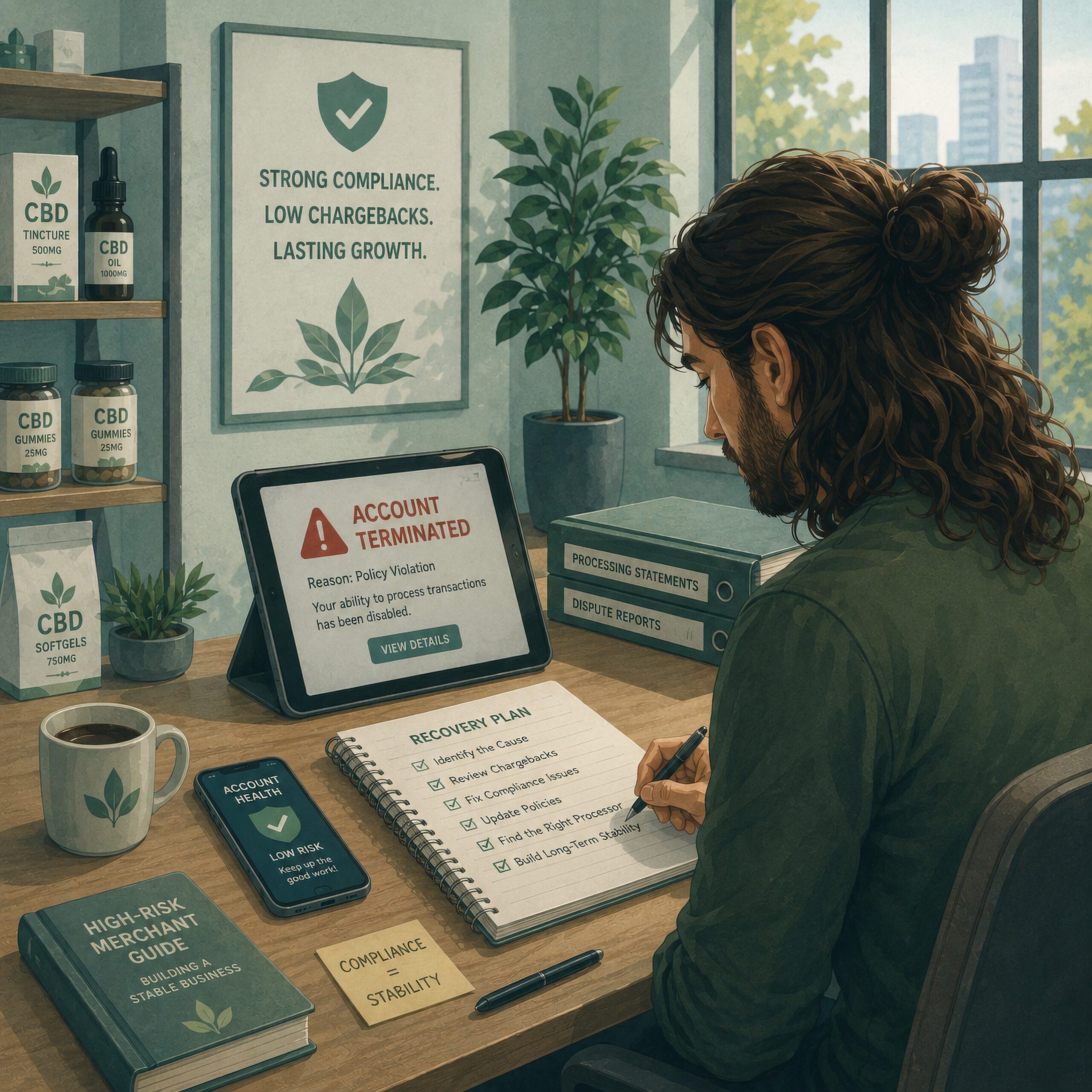
If your CBD merchant account was suddenly shut down, you are not alone — and more importantly, this situation is often recoverable. Many CBD businesses process successfully for months before receiving an unexpected notice that payouts are frozen, processing privileges are suspended, or the account has been terminated entirely.
What surprises merchants is that these shutdowns frequently happen after approval. The reality is that payment processors and acquiring banks continue monitoring merchant activity long after onboarding is complete.
Approval is easy. Durable approval is engineered.
Last Updated: May 2026
Scope: This article applies primarily to U.S.-based CBD merchants operating under federal and state payment processing requirements.
Key Highlights
- CBD merchant accounts are commonly shut down because of chargebacks, claims language, policy changes, or operational risk signals.
- Approval does not guarantee long-term processing stability.
- Banks monitor merchant behavior continuously after onboarding.
- Many shutdowns occur because merchants were placed with the wrong processor type.
- Most account closures can be prevented through stronger underwriting positioning.
- VERIFIED operates as a multi-bank broker focused on long-term stability rather than quick approvals.
Direct Answer: Why Do CBD Merchant Accounts Get Shut Down?
A CBD merchant account shutdown occurs when a payment processor or acquiring bank terminates a merchant’s ability to accept card payments because the account no longer aligns with its risk policies.
CBD merchant accounts commonly get shut down because of:
- Elevated chargebacks
- Prohibited marketing claims
- Subscription billing problems
- Sudden processing changes
- Reserve concerns
- Fulfillment problems
- Processor policy shifts
- Platform mismatches
Most merchants assume the problem is legality. In reality, many shutdowns are caused by risk behavior that differs from what the bank originally agreed to underwrite.
Banks monitor behavior, not just products.
Why CBD Businesses Face Higher Processing Risk
Regulatory Complexity
CBD exists in a more complicated environment than traditional retail products. Federal rules, state-level regulations, labeling standards, and product requirements can shift over time.
Approval criteria differ between banks because CBD creates regulatory complexity at both federal and state levels.
Businesses selling tinctures, gummies, topicals, ingestibles, or subscription products can all create different risk profiles despite operating within the same category.
For merchants evaluating long-term processing solutions, understanding CBD payment processing helps explain how underwriting and bank compatibility influence long-term stability.
Chargeback Exposure
CBD merchants frequently experience elevated dispute rates because of:
- Subscription confusion
- Billing descriptor issues
- Delivery expectations
- Customer misunderstanding
- Marketing expectations differing from actual experience
Chargebacks are predictive indicators for future losses.
Processors care less about isolated disputes and more about developing patterns.
Reputational Risk
Banks and processors evaluate public scrutiny, card network expectations, and regulatory volatility.
Even compliant CBD merchants may face heightened monitoring if processor policies evolve.
The Most Common Reasons CBD Merchant Accounts Get Shut Down
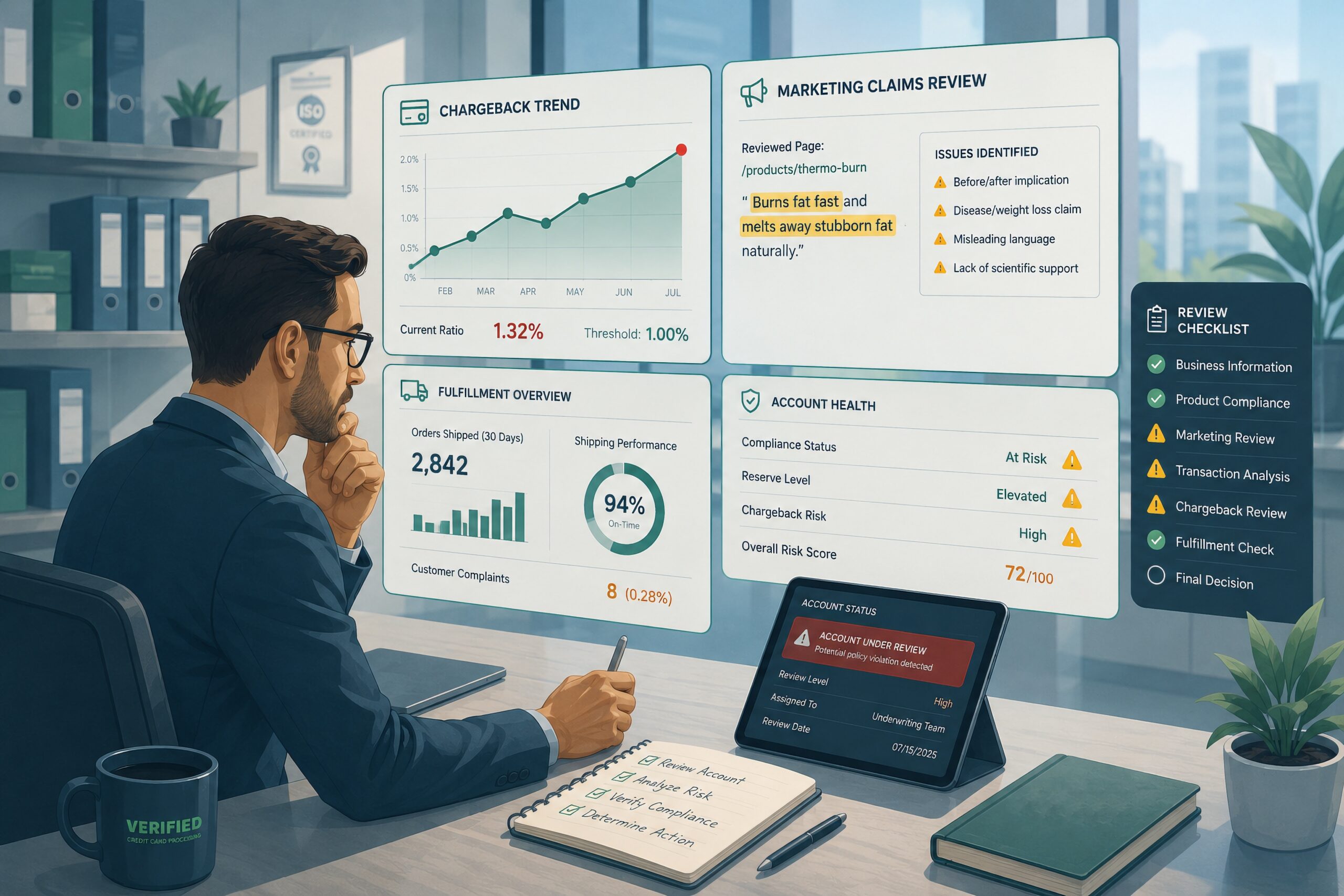
Rising Chargeback Ratios
Many processors begin enhanced monitoring around 0.75–0.90% dispute ratios.
Sustained ratios above 1% often trigger:
- Rolling reserves
- Funding delays
- Monitoring programs
- Manual reviews
- Termination risk
For merchants wanting stronger dispute prevention and monitoring, chargeback management tools can significantly improve long-term account stability.
Aggressive Product Claims
Claims language remains one of the fastest paths to compliance reviews.
Examples include:
- “Treats anxiety”
- “Cures pain”
- “Eliminates inflammation”
- “Clinically proven medical outcomes”
Even implied outcomes can create underwriting concerns.
Subscription Billing Problems
Free trials, rebill confusion, and difficult cancellation experiences commonly increase disputes.
Recurring billing frequently requires different underwriting treatment than one-time sales.
Sudden Volume Spikes
Processing $10,000 monthly and suddenly processing $75,000 may trigger reviews even when sales are legitimate.
Underwriters evaluate whether processing behavior still matches the original application.
Processor Policy Changes
Platforms like Stripe, Shopify Payments, and PayPal commonly create challenges for CBD businesses because they rely heavily on automated enforcement systems.
Aggregators approve broadly and monitor aggressively. High-risk banks underwrite deeply and monitor predictably.
Many merchants discover these limitations only after scaling.
Understanding high-risk payment compliance explains why these events occur.
Field Notes From Underwriting Reviews
Field Notes: Merchants are often surprised by what actually triggers reviews. The CBD product itself frequently is not the problem.
More commonly, processors discover new traffic sources, changing subscription funnels, aggressive affiliate language, or transaction patterns that differ from original underwriting assumptions.
Small operational changes can create large underwriting changes.
Warning Signs Your CBD Merchant Account Is Under Review
- Reserve increases
- Additional documentation requests
- Delayed settlements
- Funding holds
- Lower processing limits
- Additional underwriting questions
| Situation | Likely Processor Reaction | Merchant Impact |
|---|---|---|
| Chargebacks rise | Monitoring or reserve | Reduced cash flow |
| Claims language detected | Compliance review | Restrictions or suspension |
| Sudden volume spike | Manual review | Funding delays |
| Policy changes | Potential closure | Urgent processor replacement |
What To Do Immediately After a CBD Processor Shutdown
Step 1: Preserve Statements and Processing History
Save statements, payout reports, reserve notices, and all processor communication.
Step 2: Document Disputes
Identify patterns and determine whether specific products, subscriptions, or traffic sources contributed.
Step 3: Review Compliance
- Product claims
- Website language
- Policies
- Subscription disclosures
Step 4: Do Not Apply Randomly
Multiple rapid applications can create additional underwriting concerns.
Step 5: Determine Whether the Problem Was Operational or Structural
Operational:
- Chargebacks
- Claims language
- Fulfillment issues
Structural:
- Wrong processor type
- Aggregator mismatch
- Bank compatibility problems
Step 6: Find Underwriting-Aware Placement
Many merchants ultimately require a properly structured high-risk merchant account.
Will a CBD Merchant Account Shutdown Put You on the MATCH List?
Not every CBD merchant account shutdown results in MATCH placement.
The MATCH list (Member Alert to Control High-Risk Merchants), previously called the Terminated Merchant File (TMF), is a shared database used by acquiring banks and payment processors to identify merchants terminated for specific risk events.
Common MATCH triggers include:
- Excessive chargebacks
- Fraud concerns
- Intentional policy violations
- Money laundering concerns
- Excessive risk exposure
Being shut down alone does not automatically mean you have been placed on MATCH.
Field reality: merchants frequently confuse processor closures with MATCH placement. They are not the same event.
Understanding this distinction matters because MATCH status can affect future underwriting options.
How CBD Merchants Reduce Shutdown Risk
- Keep chargeback ratios low
- Improve customer communication
- Tighten claims language
- Maintain consistent fulfillment
- Prepare for growth events
- Use processor diversification where appropriate
Most shutdowns happen after onboarding, not before.
How VERIFIED Engineers Long-Term CBD Processing Stability
VERIFIED operates as an underwriting-aware multi-bank broker rather than a single payment processor.
Instead of forcing every merchant into one banking relationship, merchants are matched according to product category, billing model, projected volume, and operational risk profile.
VERIFIED maintains multiple acquiring relationships designed for various regulated and high-risk categories, helping merchants maintain continuity if processor policies shift over time.
A subscription-based tincture business may require different underwriting treatment than a topical product business operating entirely on one-time sales.
Processor compatibility matters more than initial approval.
Need Help Stabilizing CBD Payment Processing?
If your CBD merchant account has already been shut down — or your processor is showing warning signs like reserve increases, delayed funding, or additional documentation requests — addressing the issue early usually creates more options.
VERIFIED helps CBD merchants identify compatible acquiring relationships based on product type, processing history, billing structure, and operational risk profile.
Merchants dealing with shutdown situations often benefit from correcting the underlying issue before immediately applying elsewhere.
Further Reading
- FDA Dietary Supplement Labeling Guidance
- FTC Advertising and Marketing Guidance
- Stripe Restricted Business Policies
Frequently Asked Questions
Why was my CBD merchant account shut down?
CBD merchant accounts are commonly terminated because of rising chargebacks, compliance concerns, prohibited marketing claims, processor policy changes, or operational instability.
Can a CBD merchant get approved again after shutdown?
Yes. A shutdown does not automatically make a merchant unplaceable. Underwriting quality and proper processor positioning matter significantly.
Do all CBD merchants need reserves?
No. Reserve requirements vary depending on risk profile, processing history, volume, and operational stability.
Can Stripe process CBD payments?
Certain CBD businesses may qualify under specific rules, but many merchants encounter limitations or policy restrictions over time.
How can CBD merchants reduce shutdown risk?
Strong compliance practices, lower chargebacks, stable fulfillment, and proper processor placement improve long-term stability.
How long does it take to get a new CBD merchant account after a shutdown?
Many CBD merchants can obtain replacement processing within several business days if documentation and compliance requirements are ready.
What is a rolling reserve for CBD merchants?
A rolling reserve is a percentage of processed funds temporarily held to offset potential future risk and chargeback exposure.
Will a CBD merchant account shutdown hurt future approvals?
Not necessarily. Underwriters typically focus more heavily on why the shutdown occurred and whether the underlying issues have been corrected.

Let us discover your best options.
Either submit the form below or get in touch with an agent now (415) 835-4135.
Applying is risk-free; we send your details to underwriters to find the best fit and contact you with the best option or request more details, with no credit checks or commitments.