

Telehealth payment processing is rarely evaluated as ordinary healthcare ecommerce. An acquiring bank looks beyond whether the business is legally formed or operated by licensed providers. Underwriters examine the treatment model, prescription involvement, provider relationships, pharmacy or fulfillment path, marketing claims, recurring billing structure, patient experience, refund exposure, and financial risk created by every transaction. Online clinics and wellness brands can accept credit cards, but durable approval depends on placing the business with a bank that understands exactly how it operates. Last Updated: July 2026
Key Highlights
- A telehealth merchant account is underwritten specifically for online healthcare, medical-service, and wellness businesses that may not fit standard ecommerce rules.
- Telehealth does not automatically mean high risk, but prescription involvement, continuity billing, regulated fulfillment, medical claims, and high-ticket treatment plans can trigger specialized underwriting.
- Stripe, Square, PayPal, and other payment aggregators may support some healthcare businesses while restricting or requiring prior approval for more complex telehealth models.
- Underwriters review the complete patient and payment journey, including provider oversight, intake procedures, pharmacy relationships, website claims, cancellation terms, billing descriptors, and processing history.
- LegitScript certification or monitoring may be required for certain telemedicine, pharmacy, prescription, and healthcare models, but certification does not guarantee merchant account approval.
- Recurring treatment plans require especially clear consent, renewal disclosures, cancellation procedures, customer support, and billing descriptors.
- Depending on the risk profile, an underwriter may impose a rolling reserve, processing cap, delayed funding schedule, card-brand registration, or enhanced monitoring.
- VERIFIED works as an underwriting-aware broker across multiple acquiring banks and gateways rather than forcing every telehealth merchant into one processing program.
Direct Answer: What Is a Telehealth Merchant Account?
A telehealth merchant account is a payment processing account underwritten for an online healthcare, medical-service, or wellness business whose operating model may require more review than standard ecommerce. The merchant account allows the business to accept card payments through an acquiring bank and payment processor. Depending on the clinic, underwriting may evaluate licensed provider involvement, online prescribing, pharmacy fulfillment, treatment categories, recurring plans, average ticket size, patient disputes, compliance certifications, and the states or countries being served. A basic wellness practice selling ordinary appointments may qualify through a conventional healthcare program. A clinic facilitating online consultations, prescriptions, compounded medications, hormone therapy, weight-loss treatment, or continuity programs may require a specialized telehealth or high-risk merchant account.
Healthcare is the industry. The operating model determines the payment risk.
Telehealth Payment Terms Merchants Should Understand
Telehealth applications often become unnecessarily confusing because processors and underwriters use technical payment terminology without defining it. These are the core terms merchants are likely to encounter:
| Term | Definition | Why It Matters |
|---|---|---|
| MID | A merchant identification number assigned to a specifically underwritten merchant account. | The MID connects card activity to the approved business, website, products, services, and processing profile. |
| MCC | A merchant category code used by card networks and acquiring banks to classify the merchant’s primary business activity. | The MCC can affect eligibility, monitoring, card-brand registration, fees, and underwriting requirements. |
| Payment facilitator | A platform, sometimes shortened to PayFac, that boards merchants under a larger processing relationship instead of issuing each business a traditionally underwritten merchant account. | Payment facilitators can offer fast onboarding but may perform deeper risk reviews after processing begins. |
| ACH | Automated Clearing House payments that move funds directly between bank accounts. | ACH or eCheck may provide a secondary payment option for recurring or higher-ticket transactions. |
| Rolling reserve | A percentage of processed funds held temporarily and released according to an agreed schedule. | The reserve protects the acquiring bank from future refunds, disputes, and chargebacks. |
| PCI DSS | The Payment Card Industry Data Security Standard governing how cardholder data is handled and protected. | Telehealth merchants must protect payment data separately from their broader healthcare privacy responsibilities. |
Why Telehealth Payment Processing Is Different From Normal Ecommerce
A conventional ecommerce underwriter can usually identify the transaction clearly: a customer purchases a product, the merchant ships it, and the transaction is complete. Telehealth creates a more complicated chain involving medical services, patient eligibility, provider decisions, prescriptions, pharmacy relationships, recurring care, and outcome expectations. The bank must determine what the customer is actually paying for and who is responsible for delivering each part of the service.
Medical and Wellness Claims
Website language affects both compliance and chargeback exposure. Promises involving guaranteed weight loss, hormone optimization, restored sexual performance, disease treatment, rapid results, or guaranteed eligibility can attract scrutiny even when licensed providers are involved. Underwriters do not review claims only to determine whether they are legally defensible. They also ask whether the language could create unrealistic patient expectations and future disputes.
Licensed Provider Involvement
The underwriter may need to understand who performs consultations, where providers are licensed, which states are served, and whether the applicant is a medical practice, management services organization, marketing company, software platform, or combination of entities. A provider relationship mentioned in a website footer is not enough. The submitted underwriting file should clearly explain the clinical and contractual structure.
Prescription and Pharmacy Involvement
Businesses facilitating prescription products generally receive more review than clinics selling ordinary consultations or non-prescription wellness services. Underwriters may request information about prescribing protocols, pharmacy partners, fulfillment responsibilities, applicable licenses, card-brand registration, and healthcare certification.
Recurring Treatment Plans
Many telehealth programs combine consultations, medication coordination, support, and membership access into one monthly charge. This can create confusion if the patient believes the charge covers a specific medication while the merchant considers it a recurring clinical or membership fee. When the cardholder and merchant understand the transaction differently, disputes follow.
High Average Tickets
A disputed $500 or $1,000 treatment payment creates more exposure than an ordinary low-ticket ecommerce transaction. Higher tickets may lead to lower initial processing caps, delayed funding, additional documentation, or stronger fraud controls.
Patient Dissatisfaction
A completed consultation does not guarantee that a patient will qualify for treatment, receive a prescription, tolerate a medication, or achieve the desired outcome. The refund policy must account for that reality without promising outcomes the provider cannot guarantee.
Telehealth Businesses That May Need Specialized Payment Processing
The need for specialized processing is based on the complete business model, not merely the word “telehealth.” Examples that commonly receive enhanced review include:
- Online weight-loss clinics, including programs that may offer GLP-1 treatment
- Hormone replacement and testosterone therapy clinics
- Longevity and age-management practices
- Peptide clinics operating within a legitimate medical model
- Med spas offering online consultations or remote treatment programs
- Hair-loss treatment providers
- Erectile dysfunction treatment providers
- Dermatology and prescription skincare platforms
- At-home lab testing and diagnostic services
- Functional and integrative medicine clinics
- Supplement-backed telehealth programs
- Remote patient memberships and continuity-care programs
- Behavioral or mental wellness platforms, depending on the services and provider structure
These businesses are not automatically unprocessable. They simply require accurate classification and a bank willing to underwrite the actual service. Merchants operating specifically in medical weight loss can review the VERIFIED guide to GLP-1 merchant accounts and weight-loss payment processing. Peptide-focused businesses should also review the differences between a legitimate clinical model, a general peptide merchant account, and a research-use-only peptide business.
Why Stripe, Square, PayPal, or Shopify Payments May Not Be Stable
Payment aggregators are built to onboard large numbers of merchants quickly. That convenience can work well for straightforward businesses, but it can create instability when a telehealth model requires detailed human underwriting. An initial approval does not necessarily mean the platform has completed a full review of the clinic’s products, provider relationships, marketing, billing model, or fulfillment path. A later website scan, compliance review, dispute increase, volume spike, or treatment change can trigger restrictions after the merchant has already started processing.
Automated Approval Followed by Delayed Review
Many merchants interpret an active account as permanent approval. In reality, aggregators frequently continue reviewing businesses after transactions begin. Telehealth merchants may be flagged when automated systems detect medical terminology, prescription products, continuity billing, pharmacy relationships, or restricted treatment categories.
Restricted Categories and Prior Approval
Some payment platforms classify telemedicine, online pharmacies, prescription products, and related services as restricted rather than universally prohibited. Restricted usually means the business must receive explicit approval and may need to satisfy additional requirements. It does not mean every telehealth merchant is automatically eligible. Stripe, for example, publishes a list of prohibited and restricted businesses that distinguishes between activities that are prohibited and those requiring additional review or approval.
Sudden Funding Holds
When a processor believes future refunds or chargebacks may exceed the available balance, it may delay payouts or hold funds. That can affect pharmacy payments, provider compensation, advertising budgets, payroll, and patient support.
Account Termination
If the processor concludes that the merchant falls outside its risk appetite, it may close the account instead of restructuring it. Merchants facing an active closure should review what to do when a payment processor shuts down an account before submitting multiple rushed applications.
Instant onboarding is not the same as durable underwriting.
What Underwriters Review for a Telehealth Merchant Account
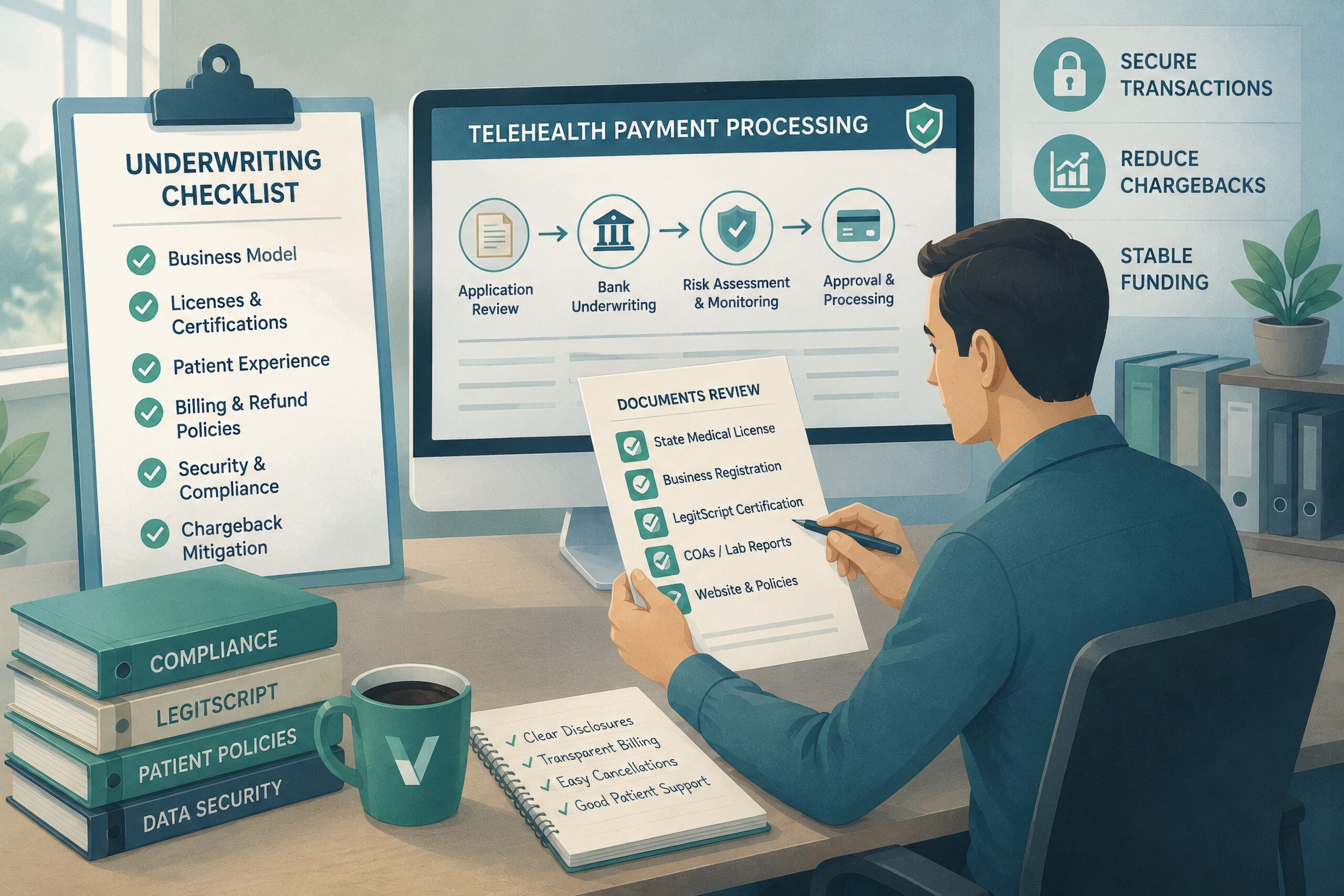
Telehealth underwriting is a structured investigation into how the business acquires patients, provides care, charges cards, and resolves problems. A strong application makes that complete process easy to understand.
| Underwriting Area | What the Bank Reviews | Why It Matters |
|---|---|---|
| Business formation and ownership | Entity records, tax identification, ownership percentages, identification, business address, and banking information | Confirms who controls the business and receives settlement funds |
| Website and patient journey | Landing pages, intake process, checkout, disclosures, policies, contact information, and treatment descriptions | Shows whether customers understand what they are purchasing |
| Provider model | Provider identities, licenses, states served, contractual relationships, and clinical responsibilities | Helps verify that care is delivered through a supportable structure |
| Treatment categories | Services, medications, diagnostics, supplements, and prescription involvement | Determines the correct risk program, MCC, and possible registration requirements |
| Pharmacy and fulfillment | Pharmacy partners, dispensing path, shipping responsibility, delivery timing, and complaint handling | Identifies who controls fulfillment and where delays may create disputes |
| Marketing claims | Advertisements, testimonials, before-and-after content, guarantees, treatment claims, and affiliate traffic | Measures regulatory, reputational, and chargeback exposure |
| Billing structure | One-time payments, subscriptions, memberships, medication fees, consultation fees, and bundled programs | Determines whether the cardholder can understand each charge |
| Refund and cancellation policies | Eligibility for refunds, cancellation timing, medication restrictions, and customer support procedures | Predicts how complaints will be handled before becoming disputes |
| Processing profile | Monthly volume, average ticket, maximum ticket, refund rate, chargeback rate, and prior statements | Allows the bank to set appropriate limits and reserve terms |
| Geographic footprint | States and countries served, provider coverage, shipping locations, and customer concentration | Prevents the account from processing outside its approved scope |
Business Formation and Financial Records
Standard documentation may include formation records, an employer identification number, owner identification, bank verification, financial statements, bank statements, and prior processing statements. Startups without processing history may need to support projections with contracts, operating plans, or evidence of capitalization.
Website Policies
The website should clearly present the legal business name, customer support information, privacy policy, terms and conditions, refund policy, cancellation rules, expected treatment process, and any limitations affecting patient eligibility. Policies should be written for actual patients, not copied from an unrelated ecommerce template.
Provider and Pharmacy Documentation
Depending on the program, the processor may request provider licenses, pharmacy information, contractual documents, compliance certification, business licenses, prescribing-flow documentation, or an explanation of how patient data moves through the system.
Processing History
Prior statements help underwriters evaluate transaction volume, average ticket, refunds, chargebacks, processing growth, and settlement behavior. A prior shutdown does not automatically prevent approval, but the cause should be disclosed and addressed directly. Merchants that have already been rejected can review why a merchant account application gets denied before applying again.
Telehealth Processing Benchmarks and Typical Underwriting Ranges
There is no universal telehealth pricing schedule. Rates and controls depend on the clinic’s treatment categories, provider structure, prescription involvement, processing history, average ticket, recurring billing exposure, and financial condition. The following are operational ranges VERIFIED commonly encounters when reviewing higher-risk telehealth and online wellness files. They are not card-network rules, guaranteed terms, or substitutes for an actual underwriting decision.
| Underwriting Term | Common Observed Range | What Can Change It |
|---|---|---|
| Underwriting review | Approximately 5–15 business days after a complete processor file is submitted | Licensing complexity, missing agreements, website revisions, pharmacy verification, and certification requirements |
| Rolling reserve | Often 5%–10% for elevated-risk programs; some files may receive no reserve or materially different terms | Processing history, chargebacks, financial strength, fulfillment exposure, average ticket, and continuity billing |
| Reserve release period | Frequently 90–180 days on programs that require a rolling reserve | Acquiring-bank policy, dispute exposure, treatment delivery, and account performance |
| Initial volume cap | Generally aligned with the monthly volume approved in the application | Prior statements, projected growth, marketing spend, financial records, and processing performance |
| Funding schedule | Often two or more business days after settlement for higher-risk ecommerce programs | Banking program, reserve structure, transaction risk, weekends, holidays, and account-review status |
A merchant should not treat these figures as an offer. A lower-risk clinic with clean processing history may receive better terms, while a startup involving prescription fulfillment, high tickets, or complex recurring billing may receive stricter controls. As of July 2026: LegitScript’s published Healthcare Certification pricing includes a $975 one-time application fee per website and a $2,150 annual certification fee per approved website. LegitScript also publishes an optional $2,500 expedited-processing charge that can begin application review within two business days. These published amounts can change and are separate from merchant account, card-brand registration, payment gateway, and transaction-processing fees. Merchants should verify current pricing directly through the LegitScript Healthcare Merchant Certification FAQ. VERIFIED may be able to provide discounted certification arrangements through applicable processing relationships, including programs that waive or reduce the standard application fee for eligible merchants.
Common Underwriting Questions Every Telehealth Application Must Answer
When an acquiring bank reviews a telehealth merchant account application, the process is often less about checking boxes and more about reducing uncertainty. Before approving an account, an underwriter is typically trying to answer five fundamental questions:
- What exactly is the customer buying? Is the payment for a consultation, membership, prescription coordination, laboratory testing, supplements, medication, or a bundled treatment program? The payment purpose should be obvious from the website, checkout, and supporting documentation.
- Who is responsible for delivering the service? The bank wants to understand whether care is provided directly by the applicant, through licensed medical providers, third-party physician groups, pharmacy partners, or another organization.
- When is the customer charged? Underwriters review whether billing occurs before a consultation, after treatment approval, at shipment, or through recurring membership billing. The timing of payment directly affects refund and chargeback exposure.
- What happens if treatment cannot be provided? Patients may not qualify for care, prescriptions may not be issued, or medications may become unavailable. The merchant’s refund, cancellation, and patient communication policies should clearly explain how these situations are handled.
- Who ultimately carries the financial responsibility? The acquiring bank needs confidence that refunds, chargebacks, customer support, and financial obligations remain with a clearly identifiable business that has the operational ability to resolve disputes.
If these five questions can be answered quickly from the application package, website, and supporting documentation, underwriting becomes significantly more straightforward. When the answers are unclear, the processor usually requests additional documentation, delays approval, imposes additional risk controls, or declines the application altogether.
Underwriting Perspective: The Bank Must Understand the Flow of Care and Money
The strongest telehealth applications explain the operational flow from the first advertisement through final fulfillment:
- The patient encounters an advertisement or referral.
- The patient reaches the clinic’s website and reviews the program.
- The patient completes intake and eligibility information.
- A licensed provider conducts or reviews the consultation.
- The provider determines whether treatment is appropriate.
- A pharmacy or another approved party fulfills any prescription.
- The patient is charged according to clearly disclosed terms.
- The merchant provides support, renewal notices, cancellation options, and refund handling.
Any unexplained handoff creates underwriting uncertainty. For example, a clinic may describe itself as the healthcare provider while contracts show that it only markets a third-party medical group. Another company may collect the full patient payment even though separate entities provide the consultation and medication. Those structures may be supportable, but they must be disclosed correctly.
Underwriters approve understandable risk more readily than hidden complexity.
Field Notes: Why a Small Telehealth File Can Still Require Detailed Review
In one anonymized telehealth application reviewed by VERIFIED, the merchant projected only about $5,000 in monthly card volume but expected an average transaction near $500. The business combined wellness coaching, specimen collection, access to medical providers, and a planned online treatment component. The projected volume was not the main underwriting issue. The larger questions were:
- Which entity would provide the medical service?
- Whether prescription treatments would be offered online
- What the patient’s $500 payment actually included
- Whether LegitScript certification would be required
- How the website, gateway, provider relationships, and cancellation terms would change when online treatment launched
The practical lesson is that underwriting complexity is not determined by monthly volume alone. A $5,000-per-month telehealth merchant can require more documentation than a conventional ecommerce business processing ten times that amount.
Low volume does not cancel structural risk.
LegitScript, Compliance Documentation, and Processor Trust
Some telehealth, online pharmacy, prescription, addiction treatment, and regulated healthcare businesses may need healthcare certification, card-brand registration, or ongoing website monitoring. The exact requirement depends on the merchant category code, products, transaction flow, acquiring bank, card brands, and countries involved. LegitScript Healthcare Merchant Certification is commonly used by telemedicine businesses to demonstrate that their operations have been reviewed against applicable standards. LegitScript states that its certification is recognized by Visa and Mastercard and can be a necessary part of the approval process for certain card-not-present healthcare transactions. Certification may also be relevant when applying to advertise through participating digital advertising platforms. However, certification is not a substitute for merchant underwriting. The acquiring bank will still evaluate:
- Ownership and financial condition
- Provider and pharmacy relationships
- Treatment categories
- Website and advertising claims
- Recurring billing practices
- Chargeback and refund history
- Average ticket and monthly volume
- Customer support and fulfillment performance
Some card-not-present pharmaceutical and telemedicine models may also require card-brand registration and additional fees. These costs must be confirmed for the specific merchant and should not be assumed until underwriting identifies the applicable MCC and registration program. VERIFIED can help eligible merchants understand whether LegitScript is likely to be required and may provide access to discounted certification pricing through applicable processing relationships. Certification and merchant account approval remain separate decisions.
Certification reduces uncertainty. It does not eliminate underwriting.
Telehealth Subscription Billing Risk
Subscription billing is not inherently unsuitable for telehealth. It becomes problematic when the patient cannot determine what is recurring, what is included, how to cancel, or whether a medication charge is separate from a membership charge.
Common Telehealth Billing Structures
- Monthly clinical membership fees
- Medication-management programs
- Consultation plus recurring support
- Diagnostic or lab-monitoring plans
- Supplement and wellness continuity programs
- Periodic treatment renewals
Why Recurring Programs Generate Disputes
Patient disputes often begin with operational confusion rather than fraud. A patient may believe the program was cancelled after requesting a pause, assume the membership ends when medication is discontinued, or fail to recognize the billing descriptor. The processor will evaluate whether the merchant provided:
- Affirmative consent to recurring charges
- The amount and frequency of billing
- A clear explanation of what the fee includes
- Renewal or rebill disclosures
- An accessible cancellation process
- Responsive customer support
- A recognizable billing descriptor
- Written confirmation of cancellations and refunds
Continuity billing should be designed as a risk-control system, not merely a revenue model. Merchants should monitor cancellation complaints, refund requests, descriptor confusion, and disputes by treatment program.
Reserves, Volume Caps, and Funding Expectations
A reserve or processing limitation does not necessarily mean the bank believes the business is improper. These controls are commonly used to limit financial exposure while the merchant establishes stable performance.
Rolling Reserves
A rolling reserve withholds a percentage of each transaction for a defined period before releasing it back to the merchant. For example, if an account has a 10% rolling reserve held for 180 days, the processor retains $10 from a $100 transaction and ordinarily releases that amount after 180 days, assuming the account remains eligible for release. For a complete explanation, review what a rolling reserve is and why high-risk merchants receive one.
Capped or Upfront Reserves
Some programs establish a target reserve balance rather than continuously holding a percentage forever. The reserve may be funded upfront, accumulated from processing, or built through a combination of both methods.
Processing Caps
The approved monthly volume is part of the underwriting decision. Processing materially above that amount without notice can trigger funding delays or account review. Telehealth merchants preparing to increase advertising should discuss expected growth with the processor before the volume appears.
Funding Delays
Funding may be delayed when transactions remain exposed to cancellation, treatment eligibility, fulfillment, or refund risk. The funding schedule should be reviewed together with the reserve, not treated as an isolated term.
Ongoing Monitoring
Underwriting continues after approval. Website content, treatment offerings, chargebacks, refunds, traffic sources, ticket size, and monthly volume may all be monitored. Adding a new treatment category without approval can place an otherwise healthy merchant account at risk.
Payment Aggregator vs. Telehealth Merchant Account vs. Alternative Payments
| Payment Option | Best Fit | Main Advantage | Primary Risk or Limitation |
|---|---|---|---|
| Payment aggregator | Simple, lower-risk wellness or professional-service businesses that fit the platform’s policies | Fast setup and straightforward integration | Restricted models may face delayed review, reserves, frozen payouts, or termination |
| Underwritten telehealth merchant account | Legal online clinics requiring dedicated healthcare, prescription, recurring, or high-risk underwriting | The business model is reviewed and assigned its own processing parameters | More documentation, possible registration, reserves, volume caps, or monitoring |
| ACH or eCheck | Higher-ticket payments, recurring plans, or merchants adding a secondary payment rail | Reduces dependence on card acceptance | Different authorization, return, fraud, and customer-experience considerations |
| Alternative hosted checkout infrastructure | Eligible merchants without an immediate conventional merchant account path | May provide an additional way for customers to complete payment | Not a conventional merchant account and may require a different customer flow |
Common Telehealth Payment Processing Mistakes
Applying Before the Website Is Complete
An unfinished website prevents the underwriter from reviewing the patient journey, policies, pricing, provider model, and treatment descriptions. Submitting too early can create an avoidable decline.
Describing the Business Too Broadly
“Healthcare,” “wellness,” or “telemedicine” does not adequately explain the risk. Underwriting needs to know what services are delivered, whether prescriptions are involved, who provides care, and how the patient is billed.
Hiding Products or Prescription Involvement
Omitting a treatment category may produce a temporary approval, but post-approval detection can lead to immediate review. Accurate disclosure creates a more defensible account.
Using One MID for Unapproved Websites or Models
A MID is approved for a specific business profile, URL set, products, services, geography, and transaction pattern. Adding brands, clinics, treatment categories, or fulfillment structures without approval can create transaction-laundering concerns.
Launching Subscriptions Without Cancellation Controls
Recurring revenue can increase business value, but poorly structured cancellation and billing procedures increase disputes. The processor sees the chargeback outcome, not the merchant’s revenue objective.
Applying With Multiple Providers at Once
Uncoordinated submissions can produce inconsistent business descriptions and duplicate underwriting activity. A broker should identify the best-fit program before distributing the file.
When No Merchant Account Is Available Immediately
Some businesses cannot secure a conventional merchant account until they complete certification, revise their website, establish processing history, clarify provider contracts, or remove an unsupported product or service. In that situation, the merchant should first determine whether the problem is temporary and correctable. A declined application may be improved through better documentation or different bank placement. It does not automatically mean the business has no payment options. For eligible WooCommerce merchants, VERIFIED Crypto Checkout may also be worth evaluating as alternative checkout infrastructure. It is not a merchant account, acquiring bank, or card processor. It uses alternative hosted checkout flows and should be evaluated separately from long-term merchant account placement. This type of infrastructure can provide an additional path while underwriting options are reviewed, but it should not be inaccurately represented as conventional credit card processing.
How VERIFIED Helps Telehealth and Online Wellness Merchants
VERIFIED Credit Card Processing operates as an underwriting-aware broker, not a single processor. We work across multiple acquiring banks, processors, gateways, and alternative payment relationships so placement can be based on the merchant’s actual risk profile. That distinction matters in telehealth because two clinics using similar language may require entirely different processing programs. One may sell professional consultations only. Another may combine online prescribing, pharmacy fulfillment, recurring treatment, supplements, and high-ticket care.
Pre-Underwriting Business Review
We help identify how the business is likely to be classified before submitting it. This includes reviewing the treatment model, website, subscription structure, provider relationships, average ticket, projected volume, and prior processing history.
Multi-Bank Placement Strategy
VERIFIED does not force every clinic through one acquiring bank. We evaluate which available partner is more likely to support the specific services, transaction profile, certifications, gateway requirements, and growth plan.
LegitScript and Documentation Guidance
When certification or monitoring appears necessary, we help the merchant understand the likely requirement and organize the payment-processing side of the file. Eligible merchants may also receive discounted LegitScript certification pricing through relevant processing relationships.
Gateway and Recurring Billing Planning
The gateway must support the clinic’s website, tokenized recurring billing, fraud controls, reporting, refunds, and customer-service process. Gateway selection should follow bank placement rather than being chosen in isolation.
Reserve and Funding Review
We explain reserve mechanics, funding schedules, processing caps, monthly costs, and registration-related expenses before the merchant accepts the program whenever those terms are available.
Fallback-Path Evaluation
When a card merchant account is not immediately available, we evaluate whether ACH, eCheck, revised underwriting, delayed submission, or alternative checkout infrastructure provides a legitimate next step. VERIFIED does not approve merchant accounts directly and cannot guarantee approval. The acquiring bank and processor make the final underwriting decision. Our role is to help merchants understand their risk profile, prepare a stronger application, and connect with payment options that are more compatible with the business.
Approval is a decision. Stability is a placement strategy.
What Telehealth Merchants Should Do Before Applying
- Document the complete business model. Explain the patient journey, provider role, pharmacy or fulfillment path, and ownership structure.
- Finish the website. Publish accurate treatment descriptions, pricing, contact information, refund terms, cancellation procedures, privacy policy, and terms and conditions.
- Separate clinical and billing disclosures. Patients should understand both how treatment decisions are made and what each charge covers.
- Prepare provider and partner records. Organize licenses, agreements, pharmacy information, certifications, and other documents likely to be requested.
- Calculate the processing profile. Know expected monthly volume, average ticket, maximum ticket, recurring percentage, refund rate, and states or countries served.
- Collect prior statements. Provide complete processing history and explain any shutdown, reserve, chargeback issue, or unusual volume movement.
- Review marketing claims. Ensure advertisements, testimonials, affiliates, and landing pages match the business submitted for underwriting.
- Apply strategically. Submit the business to a bank or processor that supports the model rather than applying to every available provider.
A telehealth merchant account should be structured around the clinic’s complete operation, not obtained through the quickest signup form. Merchants that prepare the underwriting story before processing begins are better positioned to protect funding, reduce account reviews, and scale without repeatedly rebuilding their payment infrastructure. If your online clinic, med spa, telehealth platform, or wellness brand needs payment processing, the application below gives VERIFIED enough information to evaluate the model and identify the most appropriate available path. There is no promise of approval, but there should be a clear underwriting strategy before the business begins relying on a payment account.
About VERIFIED Credit Card Processing
VERIFIED Credit Card Processing LLC is an independent payment consulting and merchant account brokerage that connects merchants with acquiring banks, processors, payment gateways, and specialized payment providers. VERIFIED is not an acquiring bank and does not control final underwriting decisions.
VERIFIED works with merchants throughout the United States and supports businesses that need underwriting-aware payment placement, including telehealth, online wellness, nutraceutical, peptide, cannabinoid, subscription, and other high-risk categories.
Phone: (415) 835-4135
Company information: What Is VERIFIED Credit Card Processing?
About the author and company: Learn more about VERIFIED
Partner availability, underwriting criteria, pricing, reserve requirements, registration requirements, and merchant eligibility are subject to provider review and change.
Further Reading
- LegitScript Certification for Telemedicine Providers
- LegitScript Healthcare Merchant Certification FAQ
- Stripe Prohibited and Restricted Businesses
- PCI Security Standards Council Standards
Frequently Asked Questions
Do telehealth businesses need a high-risk merchant account?
Not every telehealth business is high risk. A clinic providing ordinary consultations may qualify through a standard healthcare program. Prescription involvement, online pharmacy fulfillment, recurring treatment plans, compounded medications, high tickets, aggressive claims, or elevated dispute exposure can require specialized or high-risk underwriting.
Can an online clinic use Stripe for payment processing?
Some healthcare businesses may be eligible for Stripe, but telemedicine, prescription products, online pharmacies, and related services can be restricted or require explicit prior approval. An active account should not be treated as confirmation that every treatment, product, or billing model has been approved.
Why do payment processors reject telehealth merchants?
Common reasons include unsupported prescription activity, unclear provider or pharmacy relationships, incomplete licensing documentation, misleading treatment claims, weak refund policies, confusing subscriptions, prior chargebacks, excessive projected volume, or submission to a bank that does not support the business model.
Do telehealth merchants need LegitScript certification?
Some telemedicine, pharmacy, prescription, addiction treatment, and regulated healthcare models may require LegitScript certification or monitoring. Requirements depend on the services, merchant category code, acquiring bank, card brands, geography, and advertising plans. Certification does not guarantee merchant account approval.
Can med spas accept payments online?
Yes. Med spas can accept online payments when their services, provider model, website, billing procedures, and treatment categories are supported by the processor. Med spas offering prescription treatments or remote consultations may require specialized underwriting and additional documentation.
Can telehealth merchants use subscription billing?
Yes, when recurring billing is approved and clearly disclosed. The patient should understand the amount, billing frequency, included services, renewal terms, cancellation process, refund policy, and billing descriptor. Poorly explained continuity programs can produce chargebacks and account reviews.
Will a telehealth merchant account require a reserve?
A reserve may be required when the bank identifies meaningful refund, chargeback, fulfillment, continuity, or financial exposure. Higher-risk telehealth programs may see rolling reserves around 5% to 10% held for 90 to 180 days, but actual terms vary by bank and merchant profile.
How long does telehealth merchant account approval take?
A complete processor underwriting review often takes approximately 5 to 15 business days, although licensing, pharmacy verification, LegitScript certification, website changes, and missing documents can extend the process. No approval timeline is guaranteed.
What documents improve telehealth merchant account approval?
A strong file may include formation records, ownership identification, bank statements, prior processing statements, provider licenses, pharmacy or fulfillment agreements, treatment descriptions, website policies, subscription terms, refund procedures, marketing examples, and applicable healthcare certifications.
What if no merchant account provider approves the business?
The merchant should identify the reason for the declines before submitting more applications. Possible next steps may include revising the website, completing certification, clarifying provider relationships, changing the billing model, using ACH or eCheck, or evaluating alternative checkout infrastructure while a long-term underwriting path is developed.



Let us discover your best options.
Either submit the form below or get in touch with an agent now (415) 835-4135.
Applying is risk-free; we send your details to underwriters to find the best fit and contact you with the best option or request more details, with no credit checks or commitments.