
Written by VERIFIED Credit Card Processing | High-Risk Payments Specialist
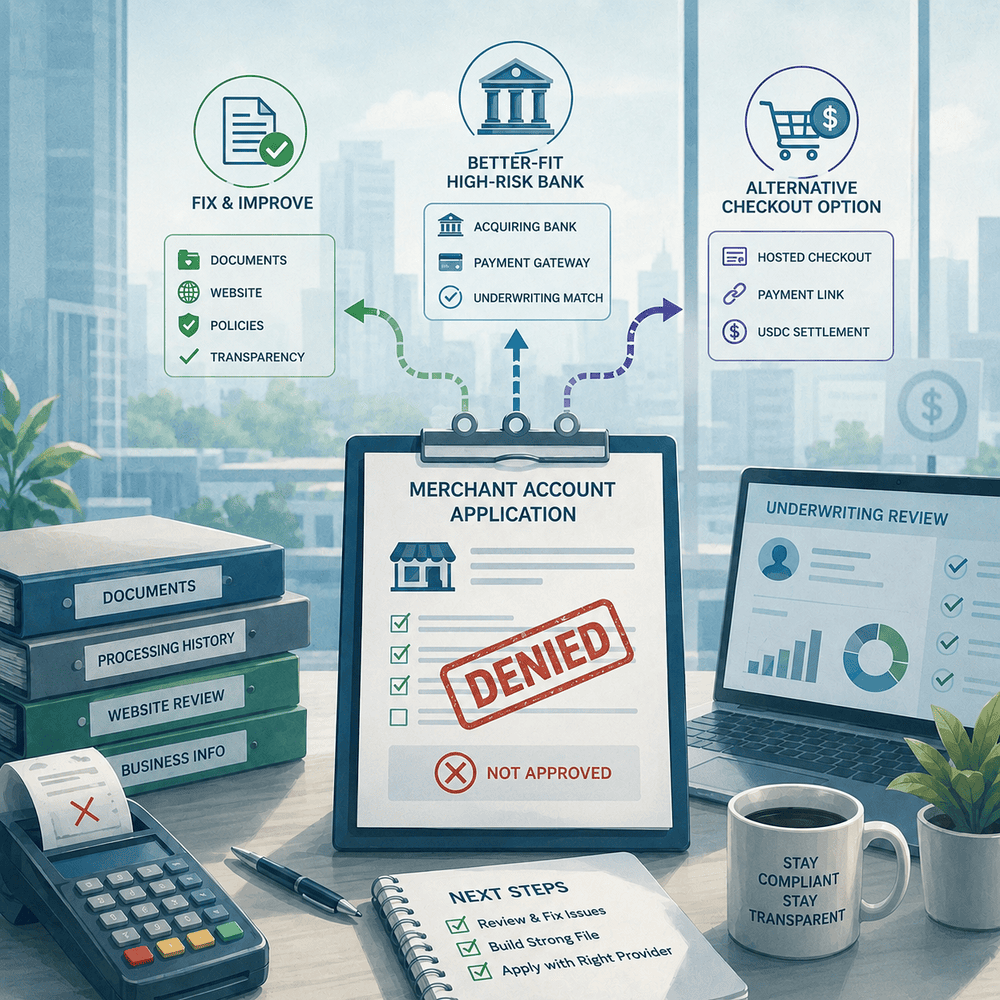
If your merchant account was denied, the first thing to understand is this: one processor’s decline is not the entire market’s answer. A denial feels final, but in underwriting it usually means the processor, acquiring bank, risk model, business category, documentation, website, or billing structure did not match what that specific underwriter was willing to approve. Sometimes the fix is a better-fit bank. Sometimes it is a cleaner website, stronger documentation, or a more accurate application. And in some cases, for merchants that cannot secure or wait for a traditional account right now, it means evaluating an alternative checkout path while the long-term processing strategy is being resolved.
Last Updated: June 2026
This guide explains why merchant account applications get denied, what underwriters actually review, how to recover after a decline, what not to do next, and where VERIFIED Credit Card Processing fits as an underwriting-aware broker for merchants who need a more durable payment processing path.
Key Highlights
- A merchant account denial means one provider or acquiring bank declined the application under its own risk standards.
- Denials are often caused by processor mismatch, missing documents, website issues, unsupported industries, chargeback history, or unclear billing practices.
- High-risk merchants are not automatically unbankable; they usually need better underwriting placement.
- Reapplying everywhere without fixing the reason for denial can make approval harder.
- VERIFIED helps merchants review underwriting fit, prepare documentation, and match with compatible acquiring banks and gateways.
- When no traditional merchant account is available right now, some eligible WooCommerce merchants may evaluate VERIFIED Crypto Checkout as an alternative checkout infrastructure option.
Direct Answer: What Does It Mean When a Merchant Account Is Denied?
A merchant account denial means a payment provider, processor, or acquiring bank decided not to approve your business for card processing under its risk standards. It is a risk decision made by one institution, not a permanent ruling that your business can never accept card payments.
A denial does not always mean the business is illegal. It does not always mean every provider will decline the merchant. It may mean the application was sent to the wrong processor, the website was not underwriting-ready, the documentation was incomplete, or the business model created more exposure than that provider was willing to take on.
Different acquiring banks specialize in different merchant profiles. A business that is an automatic decline at one processor may be a routine underwriting review at another bank that understands the category. The goal after a denial is not to panic or disguise the business. The goal is to identify the reason, fix what can be fixed, and route the next application through a better-fit underwriting path.
Merchant Account Denied vs. Merchant Account Declined
Merchants often hear several phrases that mean roughly the same thing: merchant account denied, merchant account declined, application rejected, underwriting declined, not approved, unable to board, or payment processing application denied.
In practical terms, these usually mean the same thing: the processor or acquiring bank reviewed the application and chose not to board the merchant under its current risk criteria.
The wording matters for search, but the recovery process is the same. You need to understand whether the decline came from an unsupported industry, a documentation gap, a risk trigger, a prior processing issue, or a mismatch between what was submitted and what the underwriter found during review.
Common Reasons Merchant Account Applications Get Denied
Most merchant account denials come down to a handful of underwriting concerns. Often, more than one issue is present at the same time.
- Unsupported industry: The provider simply does not board the category.
- High-risk MCC: The MCC (merchant category code) triggers stricter underwriting or an automatic decline.
- Restricted products or services: The business sells products the processor, sponsor bank, or card networks will not support.
- Unclear website: The underwriter cannot quickly understand what is being sold, who is buying, how fulfillment works, or how billing is disclosed.
- Missing policy pages: No refund policy, shipping policy, privacy policy, or terms and conditions.
- Exaggerated claims: Health, income, performance, medical, or guaranteed-result claims that create regulatory or reputational risk.
- Chargeback history: Prior statements show excessive disputes, refund problems, or unstable processing behavior.
- High average ticket: Larger transactions increase the bank’s exposure per sale.
- Subscription billing risk: Recurring billing, free trials, continuity offers, and cancellation friction are common dispute drivers.
- Long fulfillment timelines: Delayed delivery, pre-orders, travel, events, coaching programs, and future services increase liability.
- Prior termination: A previous processor shut down the account, held funds, or reported unresolved risk.
- MATCH or TMF concern: The merchant or principal may be flagged from a prior processing relationship.
- Owner-level risk: Personal credit, background, ownership structure, or identity verification concerns.
- Incomplete business documents: Missing EIN, formation documents, bank letter, voided check, IDs, statements, supplier documents, or licenses.
- Application mismatch: The application says one thing while the website, product catalog, billing model, or marketing says something else.
Underwriters do not approve what they cannot clearly understand. If you can identify which issue caused the denial, you have already done much of the work required to recover. A denial without diagnosis is frustrating. A denial with a clear reason becomes an underwriting repair project.
High-Risk Industries More Likely To Be Declined
Some industries are declined not because every merchant in the category is bad, but because the category creates higher underwriting exposure. Banks evaluate chargeback risk, fulfillment risk, regulatory risk, reputational risk, and the likelihood that the merchant will create losses after approval.
Industries that frequently see payment processor declines include:
- CBD and hemp
- Kratom
- Research peptides
- Supplements and nutraceuticals
- GLP-1 and weight loss
- Telehealth
- Med spas
- Coaching and consulting
- Online courses and digital education
- Dropshipping
- Travel and vacation rentals
- High-ticket ecommerce
- Subscription and continuity billing businesses
- Adult-adjacent or otherwise restricted categories
A high-risk classification does not automatically mean a merchant is unbankable. It means the merchant needs a processor, acquiring bank, gateway, and underwriting package aligned with the actual risk profile. That is where a broker-led approach becomes more valuable than applying blindly to general-purpose payment providers.
Denied vs. Shut Down vs. Frozen Funds vs. Rolling Reserve
Merchants often use these terms interchangeably, but they describe different payment processing problems. The fix depends on which situation you are actually facing.
| Situation | What It Means | Merchant Impact |
|---|---|---|
| Application denied | The processor or bank never approved the account. | You need another underwriting path before processing can begin. |
| Account shut down | The account was approved, then later terminated. | Processing stops, and funds may be held for risk exposure. |
| Frozen funds | The processor temporarily holds settlement while reviewing risk. | Cash flow is disrupted while the processor evaluates disputes, reserves, or account activity. |
| Rolling reserve | The processor approves the account but withholds a percentage of sales for a period of time. | The account may stay active, but working capital is reduced. |
| MATCH / TMF listing | A prior processor may have reported the merchant or principal for serious risk issues. | Future approvals become significantly harder and require specialized review. |
If your account was approved and later closed, read our guide on high-risk payment processor shutdowns. If funds are being held or a reserve was imposed, review what a rolling reserve means. If Stripe specifically shut down your account, see our guide on what to do when Stripe shuts down your account.
What Underwriters Look At Before Approval
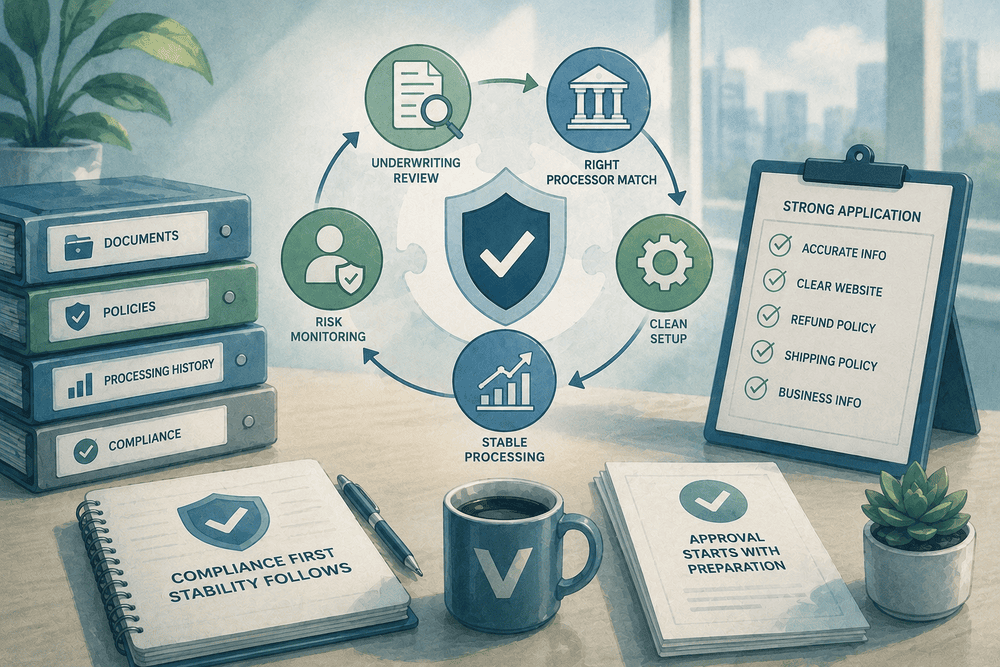
Underwriting is the process of evaluating whether a merchant can safely accept payments without creating unacceptable exposure for the processor, acquiring bank, card networks, or customers. A strong underwriting file reduces uncertainty. A weak file creates unanswered questions.
Underwriters typically review:
- Product or service type
- MCC category
- Website compliance and clarity
- Business formation documents
- Ownership and principal identity
- Fulfillment timeline
- Refund, cancellation, and shipping policies
- Visible customer support
- Billing model, including recurring or subscription terms
- Chargeback history
- Prior processing statements
- Average ticket size
- Monthly processing volume
- Highest expected ticket
- Countries served
- Marketing claims and advertising channels
- Regulatory exposure
- Prior processor history
- Whether the application matches the website and actual business model
Field Notes: In high-risk underwriting, the fastest approvals usually come from files that are boring in the right way. The website matches the application. The policies are visible. The descriptor makes sense. The products are disclosed. The average ticket is supported. The merchant can explain fulfillment. Nothing forces the underwriter to guess.
What Helps Approval After a Denial
- A clear website that matches the application
- Accurate product and service descriptions
- Visible refund, shipping, privacy, and terms pages
- A truthful application with consistent volume and ticket estimates
- Recent processing statements, if available
- A written explanation for prior chargebacks or processor issues
- Fulfillment documentation
- Supplier invoices or product documentation where relevant
- Licenses, COAs, compliance documents, or certifications where the category requires them
- A clean billing descriptor strategy so customers recognize charges
Underwriters reward merchants that are easy to understand and difficult to be surprised by. Most approval work is really surprise reduction.
What To Do After Your Merchant Account Is Denied
A denial is not the moment to apply everywhere. It is the moment to slow down, diagnose the issue, and build a cleaner underwriting path.
Step 1: Ask for the Reason for Denial
Not every provider will give a detailed answer, but ask anyway. Even a vague response can help. “Industry not supported” means something different from “incomplete documentation,” “website issue,” or “risk declined.”
Step 2: Review the Application for Mismatch
Underwriters compare what you submit against what they can verify. Look for inconsistencies between your:
- Business legal name
- DBA name
- Website
- Product catalog
- Stated monthly volume
- Average ticket
- Highest ticket
- Billing model
- Ownership
- Fulfillment timeline
- Customer support details
An application mismatch is one of the most common silent decline reasons because it makes the underwriter question whether the merchant fully disclosed the business model.
Step 3: Fix Website and Compliance Gaps
Before reapplying, make sure your website clearly includes:
- Refund policy
- Shipping policy
- Privacy policy
- Terms and conditions
- Customer service email or phone number
- Accurate product or service descriptions
- Clear billing disclosure
- Subscription cancellation terms, if recurring billing applies
- Fulfillment expectations
- Any required disclaimers or compliance language for the category
Step 4: Prepare Underwriting Documents
A clean underwriting package may include:
- Government-issued ID for each principal
- EIN confirmation
- Articles of organization or incorporation
- Operating agreement, if applicable
- Bank letter or voided check
- Recent bank statements
- Recent processing statements
- Supplier invoices
- Proof of fulfillment or shipping process
- Licenses, COAs, or compliance documentation where relevant
- Chargeback explanation letter, if prior dispute history exists
Step 5: Reapply Through the Right Channel
Reapplying to the same type of processor that just declined you usually produces the same result. If the provider does not support your industry, better paperwork will not fix the mismatch. If the website caused the decline, a different provider may still reject the same unresolved issue.
VERIFIED helps merchants evaluate why they may have been declined and identify payment providers that are more compatible with their industry, risk profile, processing volume, gateway needs, and underwriting requirements. VERIFIED is not a single processor. We work with multiple acquiring banks, processors, and gateways so merchants can pursue the path that fits the business instead of forcing the business into one rigid approval model.
Denied by a processor? Before applying somewhere else, submit a pre-application through VERIFIED. We can review your business model, processing needs, and underwriting fit before the next submission goes to a bank.
What Not To Do After a Merchant Account Denial
The wrong response to a denial can turn a fixable approval problem into a long-term processing problem. Avoid these mistakes:
- Do not lie on the application.
- Do not hide the real product or service.
- Do not use another company’s merchant account.
- Do not mislabel the business category or MCC.
- Do not open accounts under friends’ or family members’ names.
- Do not reapply repeatedly without fixing the reason for denial.
- Do not return to Stripe, Square, PayPal, or Shopify Payments without confirming policy fit.
- Do not process restricted products through an unrelated low-risk account.
The fastest way to turn a difficult approval into a long-term processing problem is to misrepresent the business. Misrepresentation can lead to termination, fund holds, monitoring, reserve increases, or worse approval conditions later. A high-risk merchant should become more transparent after a denial, not less.
Can a Denied Merchant Still Get Approved?
Yes, sometimes. Whether approval is realistic depends on why the merchant account was denied.
More Fixable Denial Reasons
- The merchant applied to the wrong processor.
- The application was incomplete.
- The website was unclear or missing policies.
- The billing model needed better disclosure.
- The average ticket or highest ticket needed explanation.
- The business had no processing history yet.
- The application was poorly packaged for underwriting.
- The processor did not understand the category.
More Difficult Denial Reasons
- Fraud concerns
- Illegal products or services
- Prohibited claims
- Active MATCH or TMF listing
- Excessive unresolved chargebacks
- Deceptive billing practices
- Owner-level risk issues
- Unsupported jurisdictions
- Products that no available banking partner will support
If the denial falls into the first group, approval may be very achievable with better preparation and placement. If it falls into the second group, the path may require remediation before reapplying, a different payment model, or a realistic discussion about whether card acquiring is available at all.
Myth: If One Processor Denied Me, Every Processor Will
This is one of the most expensive assumptions merchants make after a decline. Processors and acquiring banks do not all share the same risk appetite.
Different providers may have different positions on:
- Supported industries
- MCC categories
- Reserve requirements
- Volume caps
- Ticket-size tolerance
- Subscription billing
- Chargeback history
- Website claim standards
- Gateway compatibility
- International sales
- High-risk vertical experience
This is why processor fit matters. A merchant denied by a generic aggregator may still be approvable through a high-risk acquiring bank that understands the business model, documentation, reserve logic, and monitoring expectations.
What If You Cannot Get a Merchant Account Right Now?
Not every merchant can secure a traditional merchant account immediately. Some are repeatedly declined. Some are waiting on underwriting. Some are recovering from a shutdown or reserve. Some operate in categories where conventional card-processing options are limited, unstable, or unavailable at the moment they need to keep accepting payments.
In those cases, merchants may need to evaluate alternative checkout infrastructure while continuing to pursue long-term processing options.
VERIFIED Crypto Checkout is an alternative checkout infrastructure option that allows eligible WooCommerce merchants to use hosted checkout flows and settle in USDC without relying on a traditional merchant account.
This is not positioned as the answer for every denied merchant. If a traditional or high-risk merchant account is available, that usually remains the more familiar customer experience. Crypto Checkout is most relevant when card acquiring is unavailable, repeatedly declined, delayed, or not operationally practical right now.
VERIFIED Crypto Checkout May Be Relevant For
- Merchants repeatedly declined by traditional processors
- Merchants waiting for underwriting approval
- Merchants shut down by Stripe, PayPal, Square, or Shopify Payments
- Merchants who cannot store cards or support traditional recurring billing
- Merchants who need payment links, invoices, or QR checkout
- WooCommerce merchants who understand USDC settlement and customer checkout education
VERIFIED Crypto Checkout Is Not For
- Illegal products or services
- Merchants trying to hide what they sell
- Merchants unwilling to complete provider know your customer (KYC) checks where required
- Merchants who specifically need conventional card acquiring only
- Merchants who cannot support customer education around a newer checkout method
Merchants should also understand that alternative checkout infrastructure is not the same as card acquiring. Crypto settlement can raise operational questions around accounting, tax reporting, wallet custody, provider KYC, customer education, and stablecoin settlement procedures. Those issues do not make the model unusable, but they do mean it should be evaluated deliberately rather than treated as a universal substitute for a merchant account.
For merchants that need a no-account or immediate alternative path, VERIFIED Crypto Checkout payment links and invoices may be worth evaluating. WooCommerce merchants can also review the VERIFIED Crypto Checkout WordPress plugin.
Merchant Account vs. VERIFIED Crypto Checkout
Each payment path fits a different merchant situation. The right option depends on underwriting availability, customer expectations, risk tolerance, and operational needs.
| Option | Best For | Main Limitation |
|---|---|---|
| Traditional merchant account | Merchants who can be underwritten for conventional card processing. | Approval may be difficult in high-risk categories. |
| High-risk merchant account | Legal businesses needing specialized underwriting, gateway support, and processor matching. | May involve reserves, higher pricing, volume caps, and more documentation. |
| Payment aggregator | Lower-risk businesses with simple products, predictable fulfillment, and mainstream categories. | Restricted categories may face sudden holds, shutdowns, or account rejection. |
| VERIFIED Crypto Checkout | Merchants needing an alternative checkout path without a traditional merchant account. | Not the same as conventional card acquiring; customer experience, provider availability, and settlement fit matter. |
The strongest strategy is not to force every merchant into one option. The strongest strategy is to match the payment path to the underwriting reality of the business.
What Should You Do Next?
Use this decision flow before applying again.
| Your Situation | Best Next Step |
|---|---|
| You were denied because documentation was missing. | Fix the document package before reapplying. |
| You were denied because the provider does not support your industry. | Apply through a high-risk broker that can route the file to a compatible acquiring bank. |
| Your website was unclear or missing required policies. | Repair website compliance gaps before the next underwriting review. |
| You were approved, then shut down. | Review the shutdown trigger and avoid reapplying blindly. |
| You need payments immediately while underwriting is pending. | Evaluate whether an alternative checkout path may fit your business. |
| You have an active MATCH or serious risk issue. | Work with an experienced specialist before submitting new applications. |
How VERIFIED Helps Denied Merchants
VERIFIED Credit Card Processing helps denied merchants through two practical paths.
Path 1: Try to Secure a Traditional or High-Risk Merchant Account
This is the primary path for most merchants. VERIFIED can help with:
- Underwriting review
- Denial reason analysis
- Document preparation
- Provider fit
- High-risk placement
- Gateway strategy
- Reserve expectations
- Processor matching
- Long-term stability planning
VERIFIED operates as an underwriting-aware, multi-bank payment processing broker. We are not a single processor and we do not force every merchant into the same approval path. Our role is to understand the merchant’s risk profile and connect the business with acquiring banks, processors, gateways, or infrastructure options that are more compatible with the business model.
Path 2: Evaluate Alternative Checkout Infrastructure
For merchants where conventional card-processing options are unavailable, repeatedly declined, or too slow for the current business need, VERIFIED can discuss whether VERIFIED Crypto Checkout may fit the merchant’s WooCommerce checkout, payment link, invoice, QR checkout, or USDC settlement workflow.
Important: VERIFIED does not approve merchant accounts directly and cannot guarantee approval. We help merchants understand their risk profile, prepare for underwriting, and connect with providers or payment infrastructure options that fit the business model.
Compatibility beats fast approval when the goal is long-term payment stability. A fast approval from a poorly matched processor can still become a reserve, shutdown, or funds hold later. A slower, better-aligned underwriting path often creates a stronger foundation.
Further Reading
- PCI Security Standards Council: Merchant Resources
- Visa: Security and Compliance Resources
- Mastercard: Rules and Compliance Programs
- Stripe: Restricted Businesses
Next Steps
Denied by a processor? Submit a pre-application and VERIFIED can review your business model, processing needs, and underwriting fit. The goal is not to apply everywhere. The goal is to apply correctly.
No merchant account available right now? Learn whether VERIFIED Crypto Checkout may fit your WooCommerce checkout, payment link, invoice, QR-code, or USDC settlement workflow while you continue evaluating long-term processing options.
A denial is a starting point, not a dead end. Understand why it happened, fix what can be fixed, pursue a better-fit underwriting path, and consider alternative checkout infrastructure only when traditional options are unavailable or too slow.
Frequently Asked Questions
Why was my merchant account denied?
Your merchant account may have been denied because the processor did not support your industry, your website was unclear, documents were missing, chargeback history created concern, the application did not match the business, or the acquiring bank was not comfortable with the risk profile.
Can I get approved after being declined?
Yes, many merchants can still get approved after a decline. Approval is more likely when the issue was processor fit, incomplete documentation, website compliance, unclear billing, or poor application presentation. More serious issues such as fraud concerns, illegal products, active MATCH listings, or unresolved chargebacks are harder.
Does one denial hurt future applications?
A single denial does not usually create a blacklist. What hurts future applications is repeatedly applying without fixing the issue, submitting inconsistent information, or misrepresenting the business. Diagnose the reason before reapplying.
Is a merchant account denial the same as being on MATCH?
No. A denial means the account was not approved. MATCH, sometimes called TMF, means a prior processor may have reported the merchant or principal after a processing relationship ended. MATCH makes future approval much harder and requires specialized review.
What documents help after a denial?
Helpful documents include government ID, EIN confirmation, formation documents, bank letter or voided check, recent bank statements, processing statements, supplier invoices, fulfillment proof, licenses, COAs, and a written explanation of prior chargebacks or processor issues when relevant.
Can high-risk businesses still get merchant accounts?
Yes. Many legal high-risk businesses can still get merchant accounts through specialized underwriting. They may face higher pricing, reserves, volume caps, more documentation, and closer monitoring, but a high-risk classification does not automatically mean the business is unbankable.
What should I fix before applying again?
Fix website clarity, refund policy, shipping policy, privacy policy, terms and conditions, customer support visibility, product descriptions, billing disclosures, subscription cancellation terms, and application consistency before applying again.
Should I apply to multiple processors at once?
Applying everywhere at random can backfire. A targeted application to a better-fit provider after fixing known issues is usually stronger than sending the same weak file to several processors that may not support the category.
Can I use Stripe or PayPal after being denied elsewhere?
Only if your business category genuinely fits their policies. Using an aggregator for a restricted or high-risk product can lead to a later hold, shutdown, or funds freeze, which is often harder to recover from than the original denial.
What if no merchant account provider will approve me?
If traditional card processing is unavailable right now, some merchants evaluate alternative checkout infrastructure while continuing to pursue long-term processing options. For eligible WooCommerce merchants, VERIFIED Crypto Checkout may be one option to review.
Is VERIFIED Crypto Checkout a merchant account?
No. VERIFIED Crypto Checkout is not a merchant account, acquiring bank, payment processor, or card network. It is checkout infrastructure that may help eligible merchants use alternative hosted checkout and USDC settlement flows when traditional merchant account options are unavailable or unsuitable.
Can VERIFIED guarantee approval?
No. VERIFIED cannot guarantee approval because acquiring banks and processors make the final underwriting decisions. VERIFIED helps merchants understand their risk profile, prepare for underwriting, and connect with providers or payment infrastructure options that fit the business model.

Let us discover your best options.
Either submit the form below or get in touch with an agent now (415) 835-4135.
Applying is risk-free; we send your details to underwriters to find the best fit and contact you with the best option or request more details, with no credit checks or commitments.