

If you sell in a high-risk category, Shopify Payments can shut you down without warning. Many merchants only discover this after launch—when payouts are delayed, funds are held, or their Shopify Payments account is terminated.
For many merchants, Shopify Payments high risk issues surface only after launch—when payouts are delayed, funds are held, or accounts are suddenly terminated.
This guide explains why Shopify Payments fails high-risk merchants, what Shopify Payments actually is, which businesses are affected, and how high-risk brands still use Shopify successfully with the correct payment setup.
Key Highlights
- Shopify Payments follows payment processor risk rules—not Shopify’s storefront policies.
- Many high-risk businesses are allowed on Shopify but not approved for Shopify Payments.
- Account freezes and fund holds are risk controls, not technical errors.
- The stable solution is a high-risk merchant account paired with a Shopify-compatible payment gateway.
- VERIFIED Credit Card Processing helps merchants get placed correctly from the start.
Table of Contents
- What Shopify Payments Really Is
- Why High-Risk Merchants Get Rejected
- Who Shopify Payments Classifies as High Risk
- Shopify Payments Prohibited Businesses
- What Happens When Shopify Payments Flags Your Store
- If Shopify Payments Flags or Freezes Your Account
- How High-Risk Merchants Use Shopify Successfully
- The Correct High-Risk Shopify Payment Stack
- Shopify Payments vs Proper High-Risk Setup
- Why Most Shopify High-Risk Setups Still Fail
- Why Merchants Use VERIFIED Credit Card Processing
- When Shopify Isn’t the Right Platform
- Frequently Asked Questions
What Shopify Payments Really Is (Stripe Under the Hood)
Many merchants assume Shopify Payments is Shopify approving their business. In reality, Shopify Payments is a bundled payment service powered by third-party processors—most commonly Stripe in many regions.
Shopify itself explains that Shopify Payments allows merchants to accept card payments without setting up a separate provider, but underwriting, risk monitoring, and prohibited business enforcement follow processor rules rather than Shopify’s storefront policies.
Important distinction: Shopify approving your store does not mean Shopify Payments approves your business model.
Because Shopify Payments operates under a payment facilitator (PayFac) model, it applies conservative risk thresholds designed for low-risk, mainstream ecommerce.
Why High-Risk Merchants Get Rejected by Shopify Payments
High-risk businesses operate differently from standard ecommerce stores, which creates conflicts with Shopify Payments’ risk model.
- PayFac risk pooling: All merchants share liability under one master account.
- Chargeback sensitivity: Even modest dispute spikes can trigger reviews or reserves.
- Regulatory pressure: Banks and card networks impose strict limits on certain verticals.
- Automated compliance reviews: Product claims, fulfillment timelines, and disclosures are continuously monitored.
As a result, Shopify Payments often flags businesses that are legal and operationally sound—but incompatible with an aggregator model.
Who Shopify Payments Classifies as High Risk
Shopify Payments does not publish a single “high-risk” label, but in practice, certain business models are consistently flagged due to processor and bank risk rules.
- CBD and hemp-derived ingestible products
- Kratom and psychoactive botanicals
- Supplements and nutraceuticals with claims-based marketing
- Adult and sexual wellness products
- Vape, nicotine, and inhalable products
- Ticketing, digital goods, and high-velocity fulfillment models
Many of these businesses are allowed on Shopify as a platform but are not approved for Shopify Payments under processor underwriting rules.
Shopify Payments Prohibited Businesses
Shopify Payments maintains a list of prohibited and restricted business categories outlined in its payment terms. These rules vary by country and processor program.
- CBD and hemp-derived ingestible products
- Kratom
- Supplements and nutraceuticals
- Adult and sexual wellness products
- Vape and nicotine-related products
Key takeaway: Platform permission does not equal payment approval.
What Happens When Shopify Payments Flags Your Store
Example 1: A supplements brand processing 150 orders per day experiences a sudden volume spike. Shopify Payments places payouts on hold and requests documentation, followed by a rolling reserve with 90-day fund holds.
Example 2: A CBD merchant launches paid ads, scales quickly, and receives notice that Shopify Payments can no longer support the business model—requiring an immediate processor change.
- Payouts delayed or placed on hold
- Funds partially or fully reserved (often 90–180 days)
- Requests for additional documentation after processing begins
- Account termination requiring immediate processor replacement
If Shopify Payments Flags or Freezes Your Account
- If payouts are delayed: Pause ad scaling, gather requested documentation, and prepare for reserve requirements.
- If a reserve is placed: Plan cash flow around hold periods and begin evaluating a dedicated high-risk merchant account.
- If Shopify Payments is terminated: Remove Shopify Payments immediately and transition to a third-party gateway to avoid checkout disruption.
- If flagged before launch: Set up payments correctly before sending traffic.
How High-Risk Merchants Use Shopify Successfully
Shopify works well as a storefront. Shopify Payments often does not.
- A dedicated high-risk merchant account
- A Shopify-compatible payment gateway
- Industry-appropriate risk controls
This approach allows merchants to keep Shopify’s frontend while avoiding PayFac limitations.
The Correct High-Risk Shopify Payment Stack
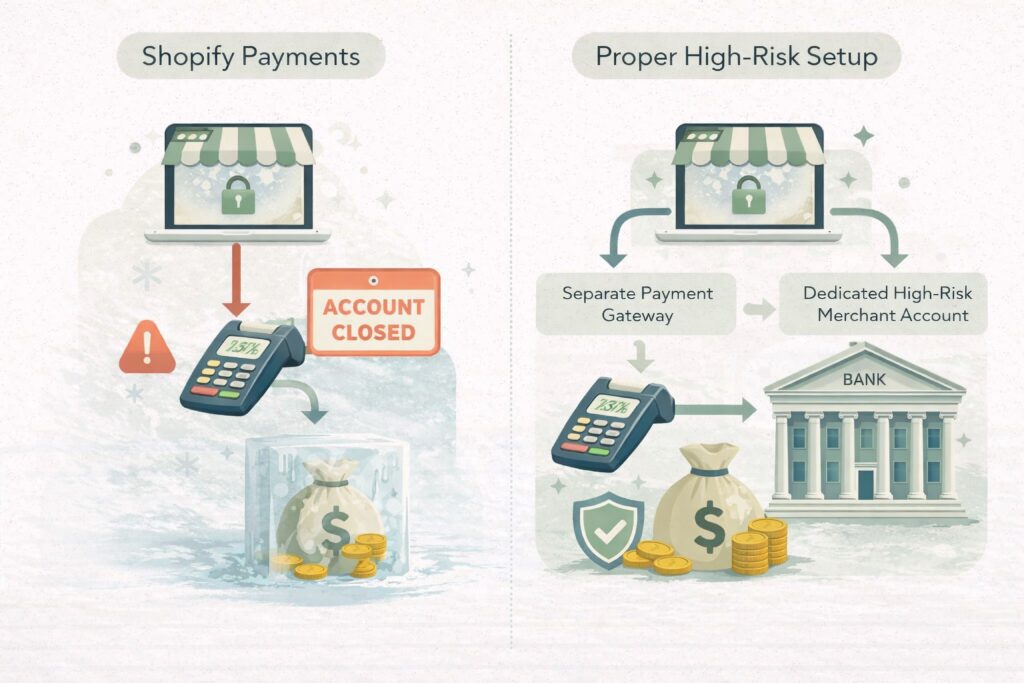
- High-risk merchant account: Underwritten for your business model.
- Payment gateway: Shopify-compatible (Authorize.Net or NMI).
- Shopify Payments removed: Eliminates aggregator risk.
- Compliance review: Policies and disclosures aligned before scaling.
- Fraud and dispute controls: Chargeback protection and alerts.
Chargeback alerts and representment (Disputifier)
VERIFIED Credit Card Processing can provide Disputifier chargeback alerts at a discounted rate for many merchants we place, helping reduce dispute ratios and protect account stability.
Checklist Before Applying for a High-Risk Shopify Processor
- Clear refund, shipping, and terms pages
- Consistent product descriptions without aggressive claims
- Recent bank statements and prior processing history
- Chargeback ratios within card network thresholds
- Documented fulfillment and support processes
Shopify Payments vs Proper High-Risk Setup
| Factor | Shopify Payments | High-Risk Merchant Account + Gateway |
|---|---|---|
| Risk Model | Aggregator / PayFac | Dedicated merchant account |
| High-Risk Industry Support | Very limited | Industry-specific underwriting |
| Fund Stability | Subject to sudden holds and freezes | Structured reserves with defined terms |
| Chargeback Tolerance | Low tolerance under PayFac rules | Managed with alerts and representment |
| Best For | Low-risk ecommerce businesses | CBD, kratom, supplements, adult, high-risk verticals |
Why Merchants Use VERIFIED Credit Card Processing
VERIFIED Credit Card Processing is a high-risk payment processing broker, not a single processor.
Typical setup timeline: For qualified merchants with complete documentation, VERIFIED can usually complete placement and gateway readiness in 3–7 business days.
Tell us your vertical, monthly volume, and chargeback situation, and we’ll map the most stable way to keep processing on Shopify—before funds are at risk.
Frequently Asked Questions on High Risk Shopify Payments
Is Shopify Payments the same as Stripe?
In many regions, Shopify Payments is powered by Stripe and follows similar underwriting rules, prohibited business categories, and risk thresholds. While Shopify provides the storefront, Shopify Payments applies processor-level risk decisions.
Can high-risk businesses use Shopify?
Yes. Many high-risk businesses can use Shopify as an ecommerce platform, but they typically cannot use Shopify Payments. High-risk merchants usually need a dedicated high-risk merchant account and a Shopify-compatible payment gateway instead.
What happens if Shopify Payments freezes my account?
If Shopify Payments flags your account, payouts may be delayed, funds may be reserved for a period of time, or the account may be terminated. Merchants are often required to switch to a different payment processor to continue accepting payments.
What is the best alternative to Shopify Payments for high-risk merchants?
High-risk merchants typically use a dedicated high-risk merchant account paired with a Shopify-compatible payment gateway. Working with a high-risk broker like VERIFIED Credit Card Processing helps ensure proper placement and long-term stability.
Can I keep Shopify and just change my payment processor?
Yes. Many high-risk merchants continue using Shopify while removing Shopify Payments and integrating a third-party high-risk payment gateway. This allows businesses to keep Shopify’s frontend while using a processor designed for their risk profile.

Let us discover your best options.
Either submit the form below or get in touch with an agent now (415) 835-4135.
Applying is risk-free; we send your details to underwriters to find the best fit and contact you with the best option or request more details, with no credit checks or commitments.