
Kratom Credit Card Processing Fees: Complete 2026 Cost Breakdown
Key Highlights
- Kratom merchant account fees are higher than standard eCommerce because most banks classify kratom as high risk.
- Typical kratom payment processing costs are 3.5%–5.5% + $0.20–$0.30 per transaction, often with a 10%–15% rolling reserve held for 6–12 months.
- To compare offers correctly, look at the total cost (rates + reserves + monthly fees + chargeback fees), not just the headline rate.
- With clean processing history and low disputes, many kratom merchants can improve terms after 3–6 months.
If you sell kratom online, you’ve probably asked the same question most kratom merchants ask: “Why are my kratom merchant account fees so much higher than everyone else’s?”
Here’s why: kratom credit card processing is priced differently than low-risk businesses because banks price for category volatility, dispute exposure, and compliance requirements. The “cheap” rates you see advertised by mainstream platforms usually don’t apply to kratom—and trying to force-fit your business into a low-risk processor can backfire fast.
This guide breaks down typical high-risk processing rates for kratom, what each fee actually means, how to spot red flags, and how to reduce costs over time without risking account stability.
Why Kratom Businesses Pay Higher Processing Fees
Kratom businesses are considered high-risk by many acquiring banks. That’s not a judgment on your company—it’s how risk models work in categories with regulatory uncertainty and higher dispute sensitivity.
Kratom is not federally banned, but kratom is not federally regulated in a uniform way. State-by-state (and sometimes city-level) restrictions create a compliance patchwork that many mainstream processors won’t underwrite.
From a bank’s viewpoint, “high risk” usually means:
- Chargeback exposure: wellness and supplement-like products tend to see more “not as expected” disputes
- Compliance overhead: underwriters expect clearer policies, site standards, and operational controls
- Category volatility: processors may tighten rules or exit categories quickly
That’s why the real comparison isn’t “2.9% vs 4.9%.” It’s the difference between a stable processing solution and a fragile setup that can fail when you need it most—during a product launch, seasonal peak, or when you’re sitting on $30k of inventory that needs to move.
Typical Kratom Merchant Account Fees
Most kratom merchant account fees fall into five categories. Understand these, and you’ll be able to compare offers accurately without getting trapped by “low rate” marketing.
| Fee Type | Typical Range | What It Covers |
|---|---|---|
| Discount Rate | 3.5%–5.5% | Percentage taken from each sale |
| Transaction Fee | $0.20–$0.30 | Fixed fee per transaction |
| Rolling Reserve | 10%–15% | Held 6–12 months (rolling release) |
| Monthly Fees | $25–$55 | Gateway + account/statement servicing |
| Chargeback Fee | $15–$25 | Per dispute filed |
1) Discount rate: the percentage fee per transaction
The discount rate is the percentage taken from each transaction. For many kratom merchants, typical ranges land around 3.5%–5.5%.
Your exact rate depends on factors like: time in business, average ticket, processing history, product mix (plain leaf vs enhanced items), expected monthly volume, and underwriting strength.
2) Per-transaction fees
Most kratom payment processing setups include a per-transaction fee, commonly $0.20–$0.30. If you have lots of smaller orders, this matters. If your average order value is higher, it’s less impactful.
3) Rolling reserve: the most misunderstood “cost”
A rolling reserve is a holdback percentage of your sales that banks keep as a safety buffer against chargebacks and refunds. Typical terms are 10%–15% held for 6–12 months.
Clear example (how “rolling” works): If you process $10,000 in a month and have a 10% reserve with a 180-day hold, $1,000 is held. After 180 days, that first $1,000 starts releasing back to you—but by then you’ve been processing for months, so releases happen continuously as older holds mature. After the initial period, it becomes close to cash-flow neutral: yesterday’s reserve releases as today’s sales create new holds.
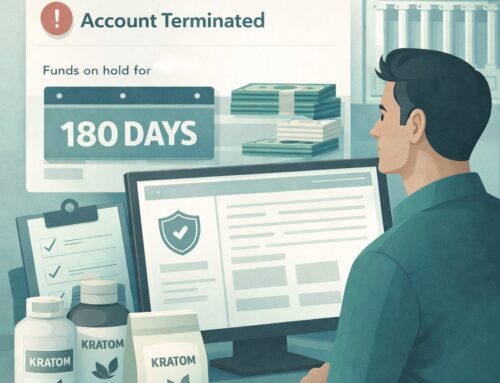
Why this matters: The reserve is often the biggest sticking point for new kratom businesses, especially if you’re bootstrapping. Yes, it creates a cash-flow gap initially. But it’s also what keeps your account from getting shut down when a small cluster of customers disputes multiple orders in a short window. The banks that “skip reserves entirely” are often the ones that terminate accounts at the first sign of trouble—and then hold all your funds for 90–180 days while they “review for risk.”
4) Monthly and account fees
Monthly fees vary, but common ones include gateway costs, account/statement fees, and sometimes PCI or platform-related charges. These aren’t automatically bad—what matters is that they’re disclosed clearly and make sense for your volume.
5) Chargeback fees
Chargebacks usually cost $15–$25 per dispute, and they’re the fastest way for your costs to rise (higher reserves, extra monitoring, and potential instability if your ratios climb). Learn how to reduce chargebacks with real-time dispute alerts and automation also get discount pricing with VERIFIED.
Why “Low Rates” Often Backfire for Kratom Sellers
If you see an offer that looks unusually cheap for kratom credit card processing, there are usually two explanations:
- Hidden fees: the headline rate is low, but the contract stacks junk fees, inflated gateway pricing, or sneaky markups
- Fragile approval: you get approved fast, but later the processor reviews your catalog and shuts you down (often after you start scaling)
If you’ve ever been hit with a sudden shutdown or funding hold, you already know the real cost isn’t the rate—it’s the disruption. For more context, see our kratom resource page: Kratom payment processing and merchant account guidance.
The most expensive processing setup is the one that fails when you need it most. Most established kratom sellers eventually learn to prioritize stability and transparency over the absolute lowest number on a sales sheet.
How to Compare Kratom Payment Processing Offers
To compare kratom payment processing costs properly, use an all-in approach:
- Discount rate + transaction fee
- Reserve percentage + reserve duration
- Monthly fees (gateway, statement, PCI, minimums)
- Chargeback fees and any monitoring requirements
- Funding speed and payout schedule
If a payment processor won’t give you written reserve terms and a clear fee schedule before you commit, that’s a strong sign the relationship will include surprises later.
You may also see either flat-rate pricing (simple and predictable) or interchange-plus pricing (more granular). Either can be fine. In kratom, transparency and stability are the real win.
How to Lower Kratom Processing Fees Over Time
Here’s the good news many kratom merchants don’t realize: high-risk processing rates aren’t carved in stone. Banks price for risk—so when you prove you’re low-risk, you can often negotiate better terms within 6 months.
1) Build clean history for your kratom merchant account (3–6 months)
After a few months of consistent volume with your kratom merchant account, low refunds, and low disputes, you can often request a review for:
- Lower reserve percentage
- Shorter reserve window
- Improved processing rates
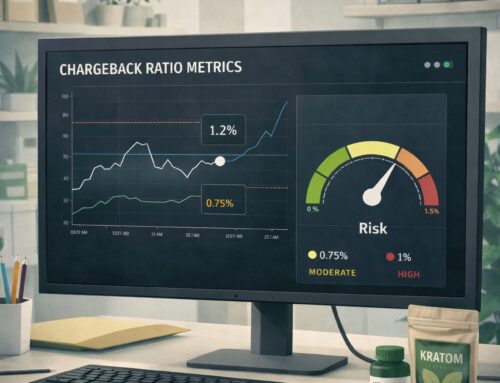
2) Keep chargeback ratio under 1% (and ideally under 0.5%)
Chargebacks are a primary driver of reserve increases and account instability. Even small improvements in disputes can unlock better long-term pricing.
Quick wins that reduce disputes:

- Use a billing descriptor that clearly matches your website name (not “Generic LLC 8005551234”)
- Respond to customer emails within 4 hours—many chargebacks happen because customers couldn’t reach you for a refund
- For subscriptions: send reminder emails 3 days before rebills
- Use delivery confirmation and save tracking numbers
- Use clear product photos and expectations to reduce “not as described” disputes
- Use a chargeback alerts tool to avoid danger to your account and chargeback representment tool to automatically fight chargebacks with evidence
3) Tighten operational “risk signals”
- Clear shipping timelines and tracking on every order
- Easy refunds for legitimate issues (refunds are usually cheaper than disputes)
- Clean product and policy language that matches what you actually sell
4) Consider redundancy when you’re established
For larger sellers, multiple merchant account solutions can improve resiliency and flexibility. (Related: High-risk merchant account structures that scale.)
Discounted Disputifier Access for Chargeback Protection
Chargebacks don’t just cost you the disputed sale—they can increase reserves, raise your credit card processing fees, and create the kind of account instability that leads to funding delays.
That’s why VERIFIED partners with Disputifier to offer discounted access to real-time dispute alerts and automation. The goal is simple: get notified early enough to resolve issues before they mature into full chargebacks—helping protect your ratios and keep your kratom merchant account in good standing.
If you’re serious about lowering long-term kratom payment processing costs, dispute prevention is one of the highest-ROI investments you can make—especially in industries like kratom. See how Disputifier chargeback protection works.
Bottom Line: What Kratom Merchants Should Expect to Pay
In most cases, kratom payment processing costs will be higher than standard retail—but that’s because you’re getting a processing solution that won’t disappear overnight. A realistic baseline often looks like:
- 3.5%–5.5% + $0.20–$0.30 per transaction
- 10%–15% rolling reserve for 6–12 months
- Monthly fees that vary by gateway and support model
What you’re buying isn’t just a rate—you’re buying a processing and merchant account setup that’s built to last in a category most mainstream providers won’t support.
For kratom vendors and kratom sellers who’ve been burned by sudden account closures or frozen funds, paying slightly higher credit card processing fees is insurance against business disruption.
VERIFIED Credit Card Processing specializes in keeping kratom merchants approved and processing. We disclose all fees in writing before you sign, work with banks who understand your category, and actively help you request rate reviews once you’ve built 3–6 months of clean history.
If you want a transparent comparison of your current fees—or want to see if we can improve your setup without risking account stability—we’re happy to review your situation with zero pressure.
Why can’t I just use Stripe or Square for my kratom business?
Mainstream processors typically prohibit kratom in their acceptable use policies. Merchants who try to sneak through by describing products vaguely often get terminated—sometimes with funds held for 90–180 days while the processor reviews risk and potential chargebacks.
Can I negotiate lower rates before I start processing?
Limited negotiation is possible if you have strong prior processing history from another high-risk merchant account, proven low chargeback ratios (under 0.75%), and expected monthly volume above $50k. But most meaningful rate improvements happen after 3–6 months of clean processing when you can demonstrate stability and low dispute rates to your acquiring bank.
What happens to my reserve if I close the account?
Rolling reserves are typically released according to the original schedule. If you have a 180-day reserve and close the account, reserve releases usually continue as each day’s held funds matures.

Let us discover your best options.
Either submit the form below or get in touch with an agent now (415) 835-4135.
Applying is risk-free; we send your details to underwriters to find the best fit and contact you with the best option or request more details, with no credit checks or commitments.