
Written by VERIFIED Credit Card Processing | High-Risk Payments Specialist
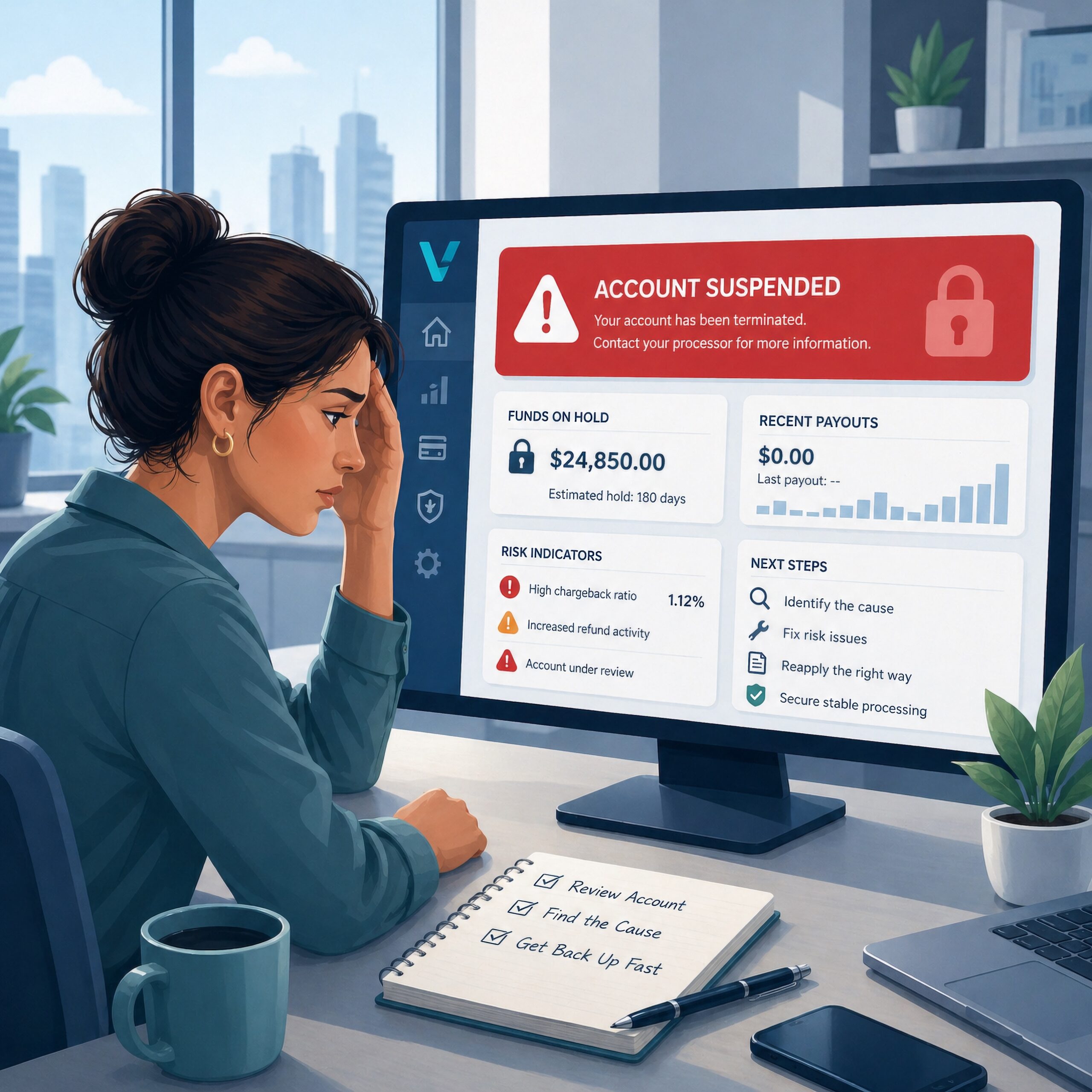
When payment processors shut down accounts, the problem is immediate. Checkout stops. Deposits may be frozen. Customers may be emailing. You need to know what happened, what not to do, and how to get back to stable processing without triggering another decline.
Most payment processor shutdowns are not random. They are usually the result of chargeback velocity, compliance exposure, policy violations, unusual volume, or a mismatch between your business model and the bank that originally approved you.
Last Updated: April 2026
Key Highlights
- Payment processors shut down accounts when risk signals exceed the acquiring bank’s tolerance.
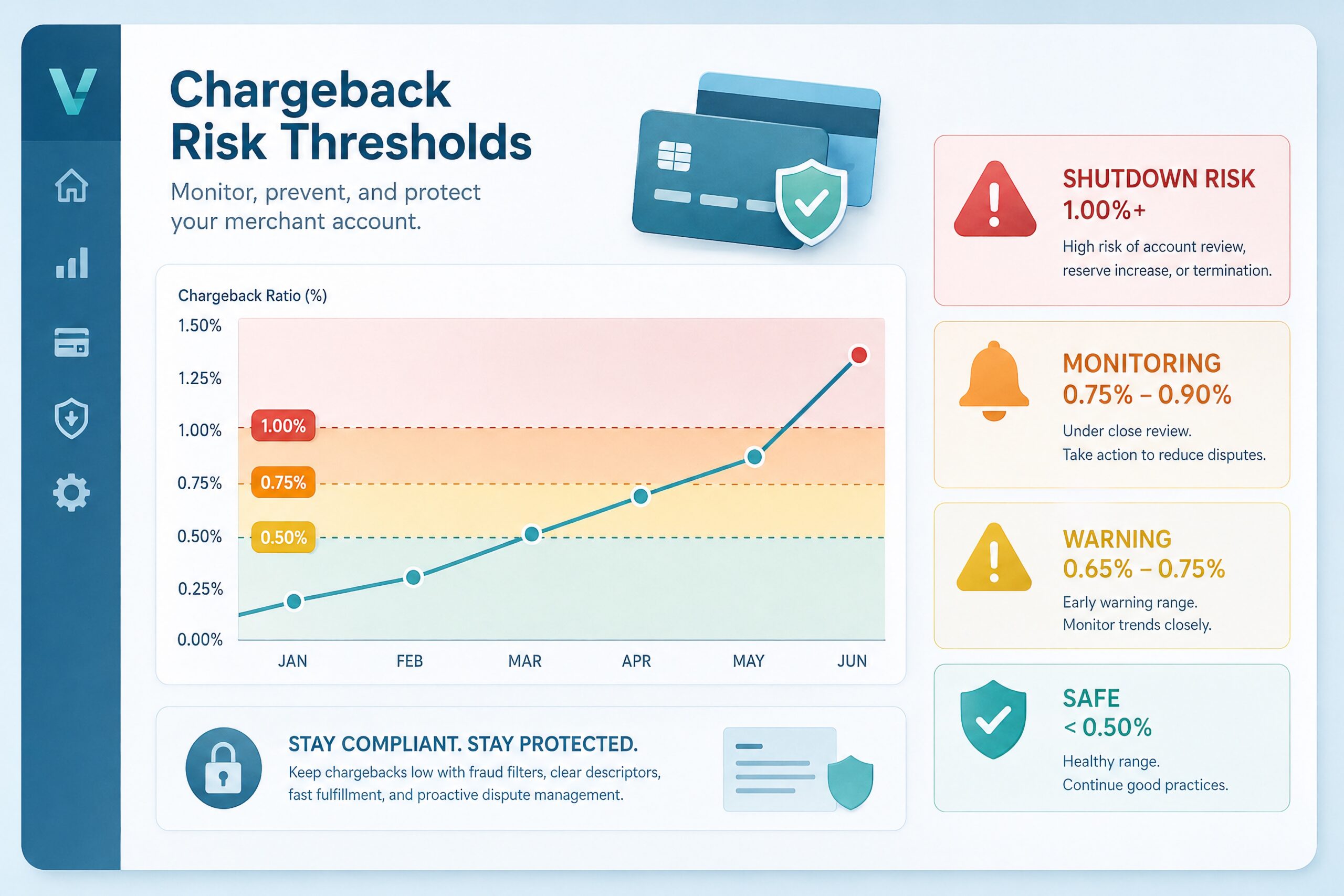
- Chargebacks near 0.75% often trigger monitoring; 1% or higher can put an account in serious danger.
- Funds are commonly held for 90–180 days after termination to cover future disputes.
- Applying to multiple processors immediately after shutdown can make approval harder.
- High-risk businesses need bank compatibility, not just another quick approval.
- VERIFIED helps merchants recover through multi-processor relationships, underwriting review, and long-term risk positioning.
Quick Answer: Why Payment Processors Shut Down Accounts
A payment processor shuts down an account when the processor or acquiring bank believes the merchant creates too much future financial, compliance, fraud, or reputational risk. In practice, that usually means chargebacks are rising, the business is outside policy, the product category was misclassified, volume changed too quickly, or monitoring found something underwriting did not originally approve.
Approval is temporary. Monitoring is permanent.
What Just Happened?
If your merchant account was terminated, the shutdown likely followed a quiet internal sequence before you received notice.
- Your transaction activity, website, chargebacks, or product category triggered a risk alert.
- The processor or acquiring bank reviewed whether your account still matched the approved risk profile.
- The bank decided the future exposure was too high.
- Processing was suspended or terminated, often with funds held in reserve.
To the merchant, this feels sudden. To the bank, it usually looks like the end of a monitoring process.
This is especially common in high-risk verticals such as kratom payment processing, CBD merchant accounts, supplements, peptides, dropshipping, online coaching, SaaS billing, and subscription commerce. Different industries create different risks, but the underwriting logic is similar: banks care about future losses before they happen.
The 8 Most Common Reasons Payment Processors Shut Down Accounts
1. Chargebacks Cross the Risk Line
Chargebacks are one of the fastest ways to lose a merchant account. Banks do not only look at the current chargeback ratio. They watch the trend.
| Chargeback Range | Typical Processor Reaction | Merchant Risk |
|---|---|---|
| Below 0.50% | Generally acceptable if stable | Low monitoring risk |
| 0.65%–0.75% | Early concern range | Processor may request explanation or remediation |
| 0.75%–0.90% | Active monitoring likely | Reserve increases or account review may begin |
| 1.00%+ | High-risk threshold | Shutdown, fines, or network monitoring risk increases materially |
If disputes are rising, use chargeback alerts, clear billing descriptors, delivery tracking, and proactive refunds before the account reaches a termination point. VERIFIED often reviews dispute patterns before placement so merchants are not simply moved into another account with the same unresolved risk.
Related guide: understanding chargeback alerts.
2. The Business Was Outside Processor Policy
Many merchants searching for “Stripe shut down my account what to do” are dealing with this issue. Aggregators like Stripe, Square, and PayPal approve many businesses quickly, then enforce policy later through automated review.
If the business sells restricted products, regulated products, supplements, hemp-derived items, peptides, adult products, coaching programs, or other high-risk offers, the account may be approved at first and terminated later.
Related comparison: Stripe vs Square for high-risk businesses.
3. Product Risk Was Misclassified
A processor may approve a merchant as general ecommerce, then later discover that the actual product category carries more risk than disclosed or understood. That mismatch can cause termination even when the product is legal.
For example, a nutraceutical brand selling basic vitamins may be viewed differently than a brand selling aggressive weight-loss supplements, nootropics, GLP-1 adjacent products, or subscription-based trial offers. A kratom merchant, peptide seller, or CBD store faces even more scrutiny because underwriting teams evaluate both product category and regulatory exposure.
4. Sudden Volume Spikes
Fast growth can trigger processor concern. A merchant moving from $15,000 per month to $85,000 per month without advance notice may look risky even if every order is legitimate.
Banks monitor volume because sudden spikes can predict fulfillment failure, fraud exposure, or future chargeback surges.
Unexplained growth is treated as risk before it is treated as success.
5. Fraud Signals Increase
Processors watch fraud indicators such as:
- Repeated declined cards
- AVS (Address Verification Service) mismatches
- CVV failures
- Card testing activity
- Unusual country or IP patterns
- High refund velocity
Fraud does not need to be massive to cause trouble. Even a short period of abnormal activity can put a merchant into review.
6. Website or Marketing Claims Create Compliance Exposure
Underwriters review more than checkout pages. They may evaluate product pages, ads, testimonials, email funnels, landing pages, refund language, subscription terms, and blog content.
For supplements, CBD, kratom, peptides, and wellness products, medical claims are a major issue. For SaaS, coaching, dropshipping, and subscription businesses, unclear cancellation terms or exaggerated income claims can create similar risk.
7. Fulfillment Problems Trigger Disputes
Late shipping, vague tracking, supplier delays, and poor customer service often become chargebacks. Dropshipping merchants are especially vulnerable because fulfillment problems can appear after sales volume increases.
Banks view fulfillment quality as a payment risk signal. If customers cannot quickly confirm where an order is, disputes usually follow.
8. The Bank’s Risk Appetite Changes
Sometimes the merchant did not change anything. The acquiring bank may simply exit a category, reduce exposure, or tighten rules after network pressure. This happens in high-risk processing more often than merchants expect.
That is why relying on one processor creates a single point of failure.
How Shutdowns Actually Happen Behind the Scenes
Processors use ongoing monitoring systems to evaluate accounts after approval. These systems may review transaction velocity, refund ratios, chargebacks, customer complaints, website changes, traffic sources, and prohibited product indicators.
Once an account is flagged, a risk team may compare the merchant’s current activity to the original underwriting file. If the business now looks different from what was approved, termination becomes more likely.
Most shutdowns are not caused by one transaction. They are caused by risk drift.
What To Do Immediately After a Payment Processor Shutdown
1. Do Not Apply Everywhere
This is the first mistake merchants make. If your merchant account is terminated, applying to five or ten processors at once can create more problems. Underwriters may see multiple recent declines, inconsistent applications, or rushed explanations.
Before reapplying, identify the real issue.
2. Preserve Your Processing Records
Download your processing statements, chargeback records, refund history, reserve notices, processor emails, gateway reports, and any termination notice. These documents help a high-risk underwriter understand whether the account failed because of risk, policy mismatch, or poor placement.
3. Expect a 90–180 Day Funds Hold
Many processors hold funds after shutdown for 90–180 days. This is not always negotiable. The hold exists because customers may still file disputes after the account closes, and the processor or bank needs funds available to cover that exposure.
The exact hold period depends on processor policy, chargeback history, transaction type, reserve terms, and perceived future risk.
4. Identify the Trigger
Look for the most likely cause:
- Did chargebacks rise in the last 30–60 days?
- Did volume increase quickly?
- Did you add a new product line?
- Did a new ad campaign change customer expectations?
- Did fulfillment slow down?
- Did the processor discover a restricted category?
5. Fix the Risk Before Reapplying
If the same business is submitted again with the same weaknesses, another decline or shutdown is likely. Repositioning matters. That may mean clearer policies, stronger fraud filters, lower initial volume caps, better chargeback prevention, updated descriptors, cleaner website language, or a more accurate category explanation.
Common Mistakes That Make Shutdowns Worse
| Mistake | Why It Hurts | Better Move |
|---|---|---|
| Applying to many processors immediately | Creates underwriting noise and inconsistent records | Prepare one clean, accurate submission |
| Hiding product category | Leads to faster termination later | Disclose the real business model upfront |
| Ignoring chargeback cause | Moves the same problem to a new account | Reduce dispute triggers before scaling |
| Using an incompatible aggregator again | Repeats the original failure | Use a high-risk compatible acquiring bank |
| Accepting offshore terms without review | Can create higher fees, slower payouts, and weaker support | Compare domestic and offshore options carefully |
The second shutdown usually happens faster than the first.
How to Get Back Up and Processing Fast
If you are searching “what to do when merchant account is terminated,” the answer is not simply “find another processor.” The right answer is: rebuild the account around the risk profile that actually exists.
Move to a High-Risk Compatible Processor
A high-risk merchant account is designed for businesses with elevated chargeback, regulatory, product, fulfillment, or reputational risk. That includes categories like high-risk merchant accounts for regulated ecommerce, subscription billing, high-ticket sales, supplements, peptides, CBD, kratom, and other harder-to-place verticals.
Use Accurate Underwriting Positioning
Underwriting is the process by which a processor or acquiring bank evaluates the merchant’s products, website, ownership, processing history, chargeback exposure, fulfillment model, and compliance controls before deciding whether to approve the account.
Bad underwriting positioning leads to unstable approval. Good positioning tells the bank what risk it is actually accepting.
Add Risk Controls Before Restarting Volume
Merchants recovering after shutdown should usually review:
- Fraud filters
- Velocity limits
- 3-D Secure options
- Chargeback alerts
- Clear billing descriptors
- Refund and cancellation flows
- Shipping and tracking communication
Plan for a Realistic Approval Timeline
After a shutdown, high-risk approval can take anywhere from a few business days to several weeks depending on documentation, category, chargeback history, volume, and bank appetite. Merchants with clean statements and a clear explanation usually move faster than merchants who apply without context.
How to Avoid Getting Shut Down Again
Once you are processing again, the goal is not simply to stay live this month. The goal is to make the account durable.
- Keep chargebacks below 1%, and ideally below 0.75%.
- Review chargeback trends weekly, not only at month-end.
- Tell your processor before major product, funnel, or volume changes.
- Keep refund, shipping, privacy, and contact policies visible.
- Audit product claims and subscription terms regularly.
- Maintain backup processing options when your category justifies it.
For merchants in verticals like kratom, hemp, peptides, nutraceuticals, SaaS subscriptions, dropshipping, and online coaching, payment processing should be treated as infrastructure — not a plug-in.
Why Multi-Bank Placement Changes Everything
High-risk payment processing is not just a higher fee category. It is a placement strategy.
High-risk payment processing refers to a structured payment setup where a merchant is matched with an acquiring bank, gateway, and risk controls that fit the business model’s actual chargeback, compliance, product, and operational exposure.
A single processor can only say yes or no based on its own risk appetite. A multi-bank broker can evaluate which bank is most compatible with the merchant’s actual risk profile.
That matters because a kratom merchant, peptide business, subscription supplement company, dropshipping store, SaaS platform, and online coaching business may all be “high-risk,” but they are not risky in the same way.
Compatibility beats approval every time.
How VERIFIED Stabilizes Merchants After Shutdowns
VERIFIED Credit Card Processing works as an underwriting-aware, multi-bank high-risk broker. That distinction matters after a shutdown.
Instead of forcing every merchant into one processor’s risk box, VERIFIED reviews the merchant’s business model, processing history, product category, website, chargeback profile, and growth pattern. From there, the goal is to match the merchant with acquiring banks and gateways that actually understand the risk.
That can include:
- Reviewing shutdown causes before reapplying
- Identifying whether the issue was chargebacks, policy mismatch, compliance, or placement
- Positioning the merchant accurately for underwriting
- Routing the file to banks with relevant category appetite
- Helping merchants build redundancy where needed
- Supporting long-term stability instead of one-time approval
Most shutdowns are not caused by bad businesses. They are caused by mismatched processing infrastructure.
If your processor closed your account, the next move matters. A clean, accurate, broker-led placement gives you a better chance of getting approved and staying approved.
Further Reading
- Visa: Rules, regulations, and fees
- Mastercard: Rules and standards
- Stripe: Restricted businesses
- PCI Security Standards Council
Frequently Asked Questions
Why did my payment processor shut down my account suddenly?
Most payment processor shutdowns happen after internal monitoring detects rising risk. Common triggers include chargebacks, fraud signals, policy violations, restricted products, sudden volume spikes, or website compliance issues. The shutdown feels sudden to the merchant, but the processor usually sees it as the result of accumulated risk signals.
How long will my funds be held after a merchant account shutdown?
Funds are commonly held for 90 to 180 days after a shutdown. The processor or acquiring bank holds funds because customers may still file chargebacks after the account is closed. The exact hold period depends on processor policy, chargeback history, transaction type, reserve terms, and perceived future exposure.
Can I open another merchant account after being terminated?
Yes, many merchants can open another merchant account after termination, but the application must be positioned correctly. Before reapplying, identify why the account was closed, gather processing statements, review chargebacks, correct compliance gaps, and work with a processor or broker that supports your actual business category.
What should I do first if Stripe shut down my account?
If Stripe shut down your account, first download your statements, termination notice, chargeback records, and payout history. Then review whether your business violated restricted business policies or triggered risk monitoring. Do not immediately apply everywhere. High-risk merchants usually need accurate underwriting placement with a compatible acquiring bank.
What chargeback ratio causes payment processors to shut down accounts?
Exact thresholds vary by processor and acquiring bank, but many high-risk merchants enter concern territory around 0.65% to 0.75%. Active monitoring often begins around 0.75% to 0.90%, and ratios near or above 1% can create serious shutdown risk, reserve increases, or network monitoring exposure.
How fast can a high-risk merchant get processing again after a shutdown?
Some merchants can be re-approved within a few business days, while more complex files may take several weeks. Speed depends on documentation quality, product category, chargeback history, processing volume, and whether the merchant has corrected the issue that caused the shutdown.
How can I prevent another payment processor shutdown?
Preventing another shutdown requires keeping chargebacks low, maintaining clear website policies, avoiding unsupported product categories, notifying processors before major volume changes, and using a bank that actually supports your business model. Multi-bank placement helps reduce the risk of relying on one processor with limited risk appetite.


Let us discover your best options.
Either submit the form below or get in touch with an agent now (415) 835-4135.
Applying is risk-free; we send your details to underwriters to find the best fit and contact you with the best option or request more details, with no credit checks or commitments.