

Written by VERIFIED Credit Card Processing | High-Risk Payments Specialist
Most kratom merchants do not lose their merchant account when they start. They lose it when they grow. Scaling introduces new risk signals that were not present at lower volume—faster transaction velocity, higher dispute exposure, operational strain, and closer scrutiny from acquiring banks. If you want to scale kratom business payment processing safely, growth has to be structured in a way banks can continue to support as volume increases.
Last Updated: April 2026
Key Highlights
- Scaling volume too quickly is one of the fastest ways to trigger re-underwriting, reserve increases, or account shutdowns.
- Chargeback velocity—not just total volume—is one of the main signals banks and payment processors monitor.
- Most kratom merchant account failures happen after approval, not during onboarding.
- Reliable payment processing at scale depends on fulfillment, support, dispute control, and compliance discipline.
- Reserve pressure often increases as merchants move into higher monthly volume tiers.
- VERIFIED helps kratom merchants scale through multi-bank placement, backup options, and underwriting-aware risk strategy.
Direct Answer: Can You Scale a Kratom Business Without Losing Payment Processing?
Yes—but only if your growth is structured in a way banks can support. A kratom merchant account becomes less stable when volume grows faster than fulfillment, customer service, dispute management, and compliance controls. The safest path is controlled growth supported by a high-risk merchant account strategy, active monitoring, and a processing partner that can adapt as your risk profile changes.
Definition: High-risk payment processing refers to merchant account placement and transaction support for businesses that banks consider more likely to produce chargebacks, compliance issues, reputational risk, or policy changes. In the kratom industry, scaling increases all four pressures at once.
Why Scaling a Kratom Business Triggers Payment Risk
Scaling changes how a kratom business is evaluated. What works at $5,000 per month may not work at $50,000 per month, even if the product line stays the same. That is because banks do not only underwrite what you sell. They underwrite how your business behaves under volume.
These are some of the most common payment processing challenges kratom businesses face as they scale:
- Volume spikes: Sudden increases can resemble unstable traffic, affiliate abuse, fraud, or a business model shift the bank did not approve.
- Chargeback velocity: A dispute rate that looked manageable at low volume can rise quickly when support and fulfillment fall behind demand.
- Operational strain: Delays in shipping, inventory problems, or inconsistent customer communication create preventable disputes.
- Risk reclassification: The acquiring bank may decide your kratom merchant account no longer fits the original underwriting profile.
Chargebacks are not just a metric. They are a predictive risk signal. Banks monitor dispute velocity because it often predicts future fraud exposure, refund pressure, and reserve losses before those problems fully materialize.
In practice, many high-risk programs begin heightened monitoring once chargebacks trend toward 0.75%, and sustained ratios above 1% usually trigger a more serious review. Volume can have a similar effect. A merchant that doubles monthly processing in 30 to 60 days without warning the bank often gets reviewed even if current chargebacks still look acceptable.
For a deeper look at this pressure point, see kratom chargebacks.
The Biggest Scaling Mistakes Kratom Merchants Make
Scaling Ads Before Operations Are Ready
Many kratom merchants increase ad spend as soon as conversion rates look promising. The problem is that payment processing feels the operational damage before the marketing team does. Lower-quality traffic, higher refund rates, and more customer confusion can move a stable account into a riskier profile quickly. A bank may not care that revenue is rising if the transaction quality behind that revenue is getting worse.
Letting Fulfillment Lag Behind Demand
Shipping delays are one of the most common causes of scaling-related disputes. A kratom business that fulfills cleanly at one volume tier can start producing “item not received” chargebacks as soon as inventory, staffing, or supplier coordination falls behind. From the bank’s perspective, that is not a warehouse problem. It is merchant account risk.
Waiting Too Long to Fix Customer Support
Weak support becomes expensive at scale. Customers who cannot get a response, find tracking, or understand a billing descriptor are more likely to call the bank instead of the merchant. At low volume, this may look manageable. At higher volume, it creates dispute velocity that gets noticed fast by banks and payment processors.
Ignoring Dispute Trends Until the Ratio Looks Bad
Merchants often react only when the headline chargeback number becomes uncomfortable. That is too late. Dispute sources should be monitored by campaign, SKU, descriptor complaints, and fulfillment lag well before the overall ratio becomes dangerous. The trendline matters as much as the final number.
Assuming Approval Means the Account Is Safe
This is one of the most expensive misconceptions in high-risk payment processing. An approved account is not the same as a stable account. Many kratom merchant accounts are placed successfully at the start, then fail later because the growth pattern no longer matches what the bank believed it was underwriting. That is why so many cases covered in kratom merchant account shut down scenarios are really scaling failures disguised as processor problems.
VERIFIED underwriting position: Fast growth exposes weaknesses. Banks do not wait for merchants to fix them.
How Banks React to Rapid Growth
Rapid growth does not go unnoticed. Both banks and payment processors review whether your growth pattern still aligns with the risk tolerance of the program you were placed into.
Common reactions include:
- Monitoring programs: Increased scrutiny of transactions, dispute trends, traffic sources, descriptors, and shipping performance
- Reserve increases: A rolling reserve that began at 10% can move to 12.5%, 15%, or even higher if the bank sees rising exposure
- Volume caps: Temporary limits on how much your payment processing account can handle while the bank evaluates new activity
- Re-underwriting: A fresh review of your business model, site content, customer experience, and processing history
- Delayed funding or documentation requests: The bank may ask for updated statements, fulfillment proof, or compliance evidence before allowing continued growth
Definition: Re-underwriting is the process by which an acquiring bank reassesses an existing merchant account after approval because volume, disputes, product mix, traffic patterns, or operational behavior have materially changed.
Underwriting is not a one-time event. It is an ongoing review process. That is one reason kratom underwriting guidelines matter just as much after approval as they do during onboarding.
VERIFIED underwriting position: Approval gets the account open. Compatibility keeps it open.
How to Scale Volume Safely
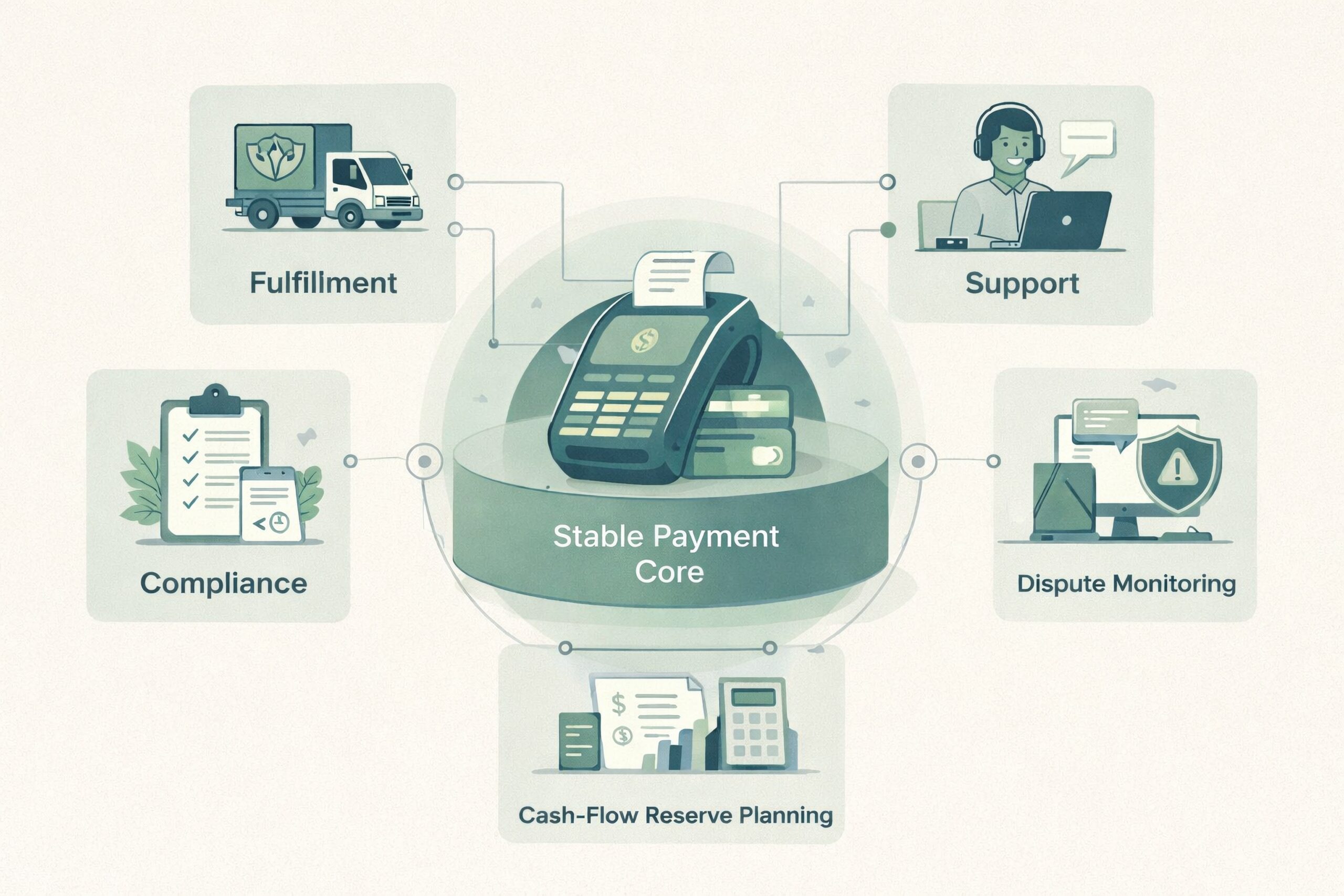
Safe scaling is not about slowing down for no reason. It is about making sure revenue growth does not outrun the controls that protect your merchant accounts. This is the foundation of high-risk payment processing stability.
- Increase volume gradually
Large jumps create suspicion. Gradual growth gives the bank time to observe a stable pattern instead of a sudden risk event. - Stabilize fulfillment before scaling marketing
If your warehouse, shipping process, or supplier chain cannot absorb the next volume tier, your payment processing will feel the damage first. - Improve customer communication
Delivery expectations, clear descriptors, responsive support, and easy refund resolution reduce preventable disputes. - Track disputes weekly
Do not wait for a monthly summary. Monitor dispute sources by campaign, SKU, fulfillment lag, and billing complaints. - Plan for reserves and cash flow pressure
Reserve increases are common in high-risk merchant accounts as volume grows. Merchants that treat reserves as a surprise usually mismanage working capital. - Notify your processor before major spikes
If a campaign, promotion, or new traffic source is expected to drive a large jump, proactive communication can prevent a risk response later.
Many banks are more comfortable with steady month-over-month growth in the 10% to 25% range than with a sudden doubling of volume. The exact tolerance varies by acquiring bank, but the pattern is consistent: controlled growth is easier to defend than abrupt growth, even when both produce the same top-line revenue eventually.
VERIFIED underwriting position: Approval is easy. Durable approval is engineered.
When to Add Backup Payment Infrastructure
At low volume, a single kratom merchant account may appear sufficient. At higher volume, that becomes fragile. A single account tied to one bank creates a single point of failure.
That is why scaling merchants eventually need backup payment solutions built into their structure. This can include additional merchant accounts for redundancy, a secondary payment gateway, and alternative rails such as ACH or eCheck for resilience.
Definition: Multi-MID routing means structuring payments across more than one merchant ID so volume is not dependent on a single account or sponsor bank. For scaling merchants, this matters because it reduces concentration risk. If one bank tightens limits, exits the category, or pauses volume, the business is less likely to go fully offline.
A secure payment gateway matters here, but gateway access alone is not the strategy. The real objective is stable payment processing across changing bank policies, not just technical checkout functionality. At scale, your payment processing account becomes part of your core infrastructure. If it fails, revenue stops immediately.
How to Structure a Kratom Business for Long-Term Stability
Keep Product Mix Underwriting-Friendly
Not all kratom catalogs are viewed the same way. Straightforward powder and capsule inventory is usually easier to support than more aggressive, novelty-driven, or controversial SKUs. As a kratom business grows, product mix matters more because the bank is evaluating not just volume, but whether that volume is being generated from a profile it still wants to support.
Protect Traffic Quality as You Scale
Traffic source quality has a direct effect on merchant account stability. Repeat customers, branded search, and controlled acquisition channels usually produce cleaner behavior than unpredictable paid traffic. When a merchant scales too quickly through lower-intent traffic, customer complaints and chargebacks often rise before revenue quality problems become obvious internally.
Make Billing Clarity Non-Negotiable
Clear billing descriptors reduce confusion-driven disputes. This sounds basic, but it becomes more important at scale because customer memory weakens when order volume rises and recurring confusion starts to compound. A recognizable descriptor, clear receipts, and easy-to-find support paths all reduce preventable chargebacks.
Maintain Compliance as Volume Increases
Compliance is not something a kratom merchant sets up once and forgets. Age controls, website policy clarity, product presentation, and restricted-region controls all need to stay aligned as the business expands. More volume means more visibility, and more visibility means less room for sloppy execution. For more on this side of the equation, see kratom payment compliance.
Keep the Business Model Understandable to the Bank
A business model that remains clear to underwriters is more stable than one that changes faster than documentation can keep up. Banks get uncomfortable when the account they approved begins to look operationally different six months later. Stable payment processing depends on keeping growth legible, not just profitable.
How a Broker Supports Scaling
This is where the difference between a single processor and an underwriting-aware broker becomes obvious. Scaling merchants rarely need a generic payment processor. They need a processing partner that understands how banks evaluate growth.
VERIFIED is not a single processor. We work across multiple acquiring banks and merchant account structures so merchants can be matched intelligently based on product mix, traffic profile, dispute exposure, and scaling plans.
That matters because a strong processing partner can help with:
- Multi-bank flexibility: matching the kratom business to a bank that actually supports its growth profile
- Fallback planning: adding redundancy before a disruption happens
- Risk balancing: structuring merchant accounts around realistic exposure, not optimistic assumptions
- Growth-stage placement: helping merchants move from a starter account into a more scalable high-risk merchant account structure when needed
- Long-term stability: focusing on reliable payment processing instead of chasing the easiest approval path
Most processors board the account and react later. VERIFIED approaches kratom merchant payment processing more like risk architecture. The goal is not simply to process kratom today. It is to build a setup that supports kratom tomorrow, at higher volume, with less fragility.
For a broader overview, see kratom merchant account.
Scaling Checklist
- Increase monthly volume in controlled stages
- Review dispute trends every week, not every month
- Keep fulfillment speed aligned with demand
- Notify your provider before major volume spikes
- Maintain clear website policies and billing descriptors
- Prepare for reserve increases as growth continues
- Separate risky traffic or promotional experiments from core stable volume when possible
- Use fraud tools and chargeback controls before problems escalate
- Build backup merchant accounts before you need them
- Work with a broker that specializes in high-risk payment processing, not just basic approval
Growth Without Processing Stability Is Not Real Growth
Serious kratom operators do not just ask whether they can get approved. They ask whether the account will still be stable after the next traffic push, the next product expansion, and the next jump in monthly volume. That is the real scaling question.
The merchants that stay live long term are usually not the ones that grew fastest. They are the ones that made growth bankable. They built support before complaints spiked, fulfillment before disputes climbed, and backup infrastructure before a processor problem turned into a revenue outage.
If your volume is increasing, your current setup feels fragile, or your bank has started asking harder questions, that is usually the point to work with an underwriting-aware broker like VERIFIED—before the next growth phase becomes the event that destabilizes your processing.
Frequently Asked Questions
Why do kratom merchant accounts fail during scaling?
Kratom merchant accounts often become unstable during scaling because volume rises faster than fulfillment, support, dispute control, and compliance systems. That change can trigger monitoring, reserve increases, or re-underwriting by the bank.
What is the safest way to scale a kratom business without losing payment processing?
The safest approach is controlled growth. Increase volume gradually, keep fulfillment stable, monitor chargebacks weekly, maintain compliance, and work with a high-risk processing partner that can support growth without relying on one bank.
Do banks raise reserves when a kratom business grows?
Yes, they often do. As a kratom business scales, banks may raise rolling reserves to offset expected dispute or refund exposure. Reserve increases are common in high-risk payment processing when growth creates new risk.
Should high-volume kratom merchants have more than one merchant account?
Usually yes. Once a kratom merchant reaches meaningful volume, backup merchant accounts or multi-MID structures improve stability and reduce dependency on a single acquiring bank.
What usually triggers re-underwriting for a kratom merchant account?
Re-underwriting is commonly triggered by sudden volume spikes, rising chargeback trends, changes in product mix, operational problems, or other signs that the business now looks different from what the bank originally approved.
At what chargeback level do banks start reviewing a scaling kratom account more closely?
Many high-risk programs begin heightened monitoring once chargebacks trend toward 0.75%, and sustained ratios above 1% usually trigger a more serious review. Exact thresholds vary by bank, but those ranges are common in practice.

Let us discover your best options.
Either submit the form below or get in touch with an agent now (415) 835-4135.
Applying is risk-free; we send your details to underwriters to find the best fit and contact you with the best option or request more details, with no credit checks or commitments.