Written by VERIFIED Credit Card Processing | High-Risk Payments Specialist
Most kratom merchants think the hard part is getting approved. It is not. The hard part is getting approved into a banking relationship that can actually survive ongoing monitoring. Banks do not underwrite kratom the way they underwrite standard ecommerce. They review the full operating picture: product mix, website language, shipping controls, dispute exposure, compliance posture, and whether the merchant looks stable enough to support long-term card acceptance.
That is why two kratom businesses selling similar products can have completely different outcomes. One gets a stable merchant account. The other gets boarded into a weak fit, triggers monitoring, and ends up shut down months later. Understanding kratom underwriting guidelines helps merchants build for compatibility instead of chasing easy approval.
Last Updated: March 2026
Key Highlights
- Banks underwriting kratom merchants evaluate the entire business operation, not just whether kratom is legal where you sell.
- Kratom merchant accounts face enhanced underwriting because of regulatory fragmentation, reputational risk, and elevated dispute exposure.
- Product presentation, website compliance, shipping controls, and chargeback ratios strongly influence approval outcomes.
- Plain leaf powder and capsule catalogs are usually easier to underwrite than concentrated extracts or 7-OH-heavy product lines.
- Transparency beats cleverness in high-risk underwriting. Merchants who present their business clearly and completely are far more likely to secure durable approvals.
What Are Kratom Underwriting Guidelines?
Kratom underwriting guidelines are the risk standards acquiring banks, processors, and underwriting teams use to determine whether a kratom merchant can be approved for payment processing and whether that approval can remain stable after onboarding.
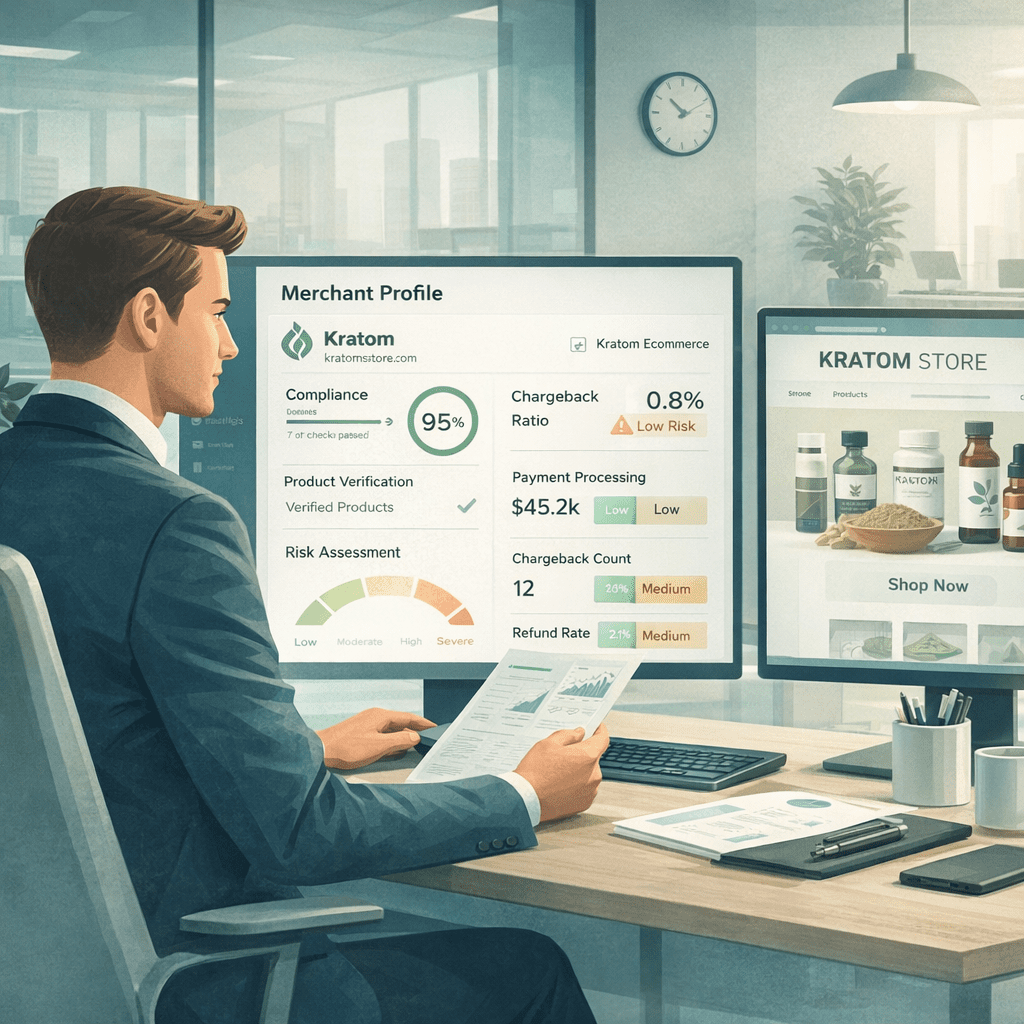
Underwriting is the process banks use to evaluate merchant risk before allowing card payments. In kratom, this evaluation goes deeper than standard ecommerce because banks examine not just the business entity, but also the regulatory environment, product catalog, website claims, shipping controls, and expected dispute exposure.
- Product types and labeling
- Website marketing claims
- Geographic shipping restrictions
- Refund and customer service policies
- Prior payment processing history
- Overall operational transparency
This is why merchants searching for a kratom merchant account often receive very different answers from different providers.
Approval is easy. Durable approval is engineered.
Direct Answer: How Banks Evaluate Kratom Merchants
Banks evaluate kratom merchants by determining whether the business can operate within a controlled and predictable risk environment.
The kratom merchant account approval process typically includes:
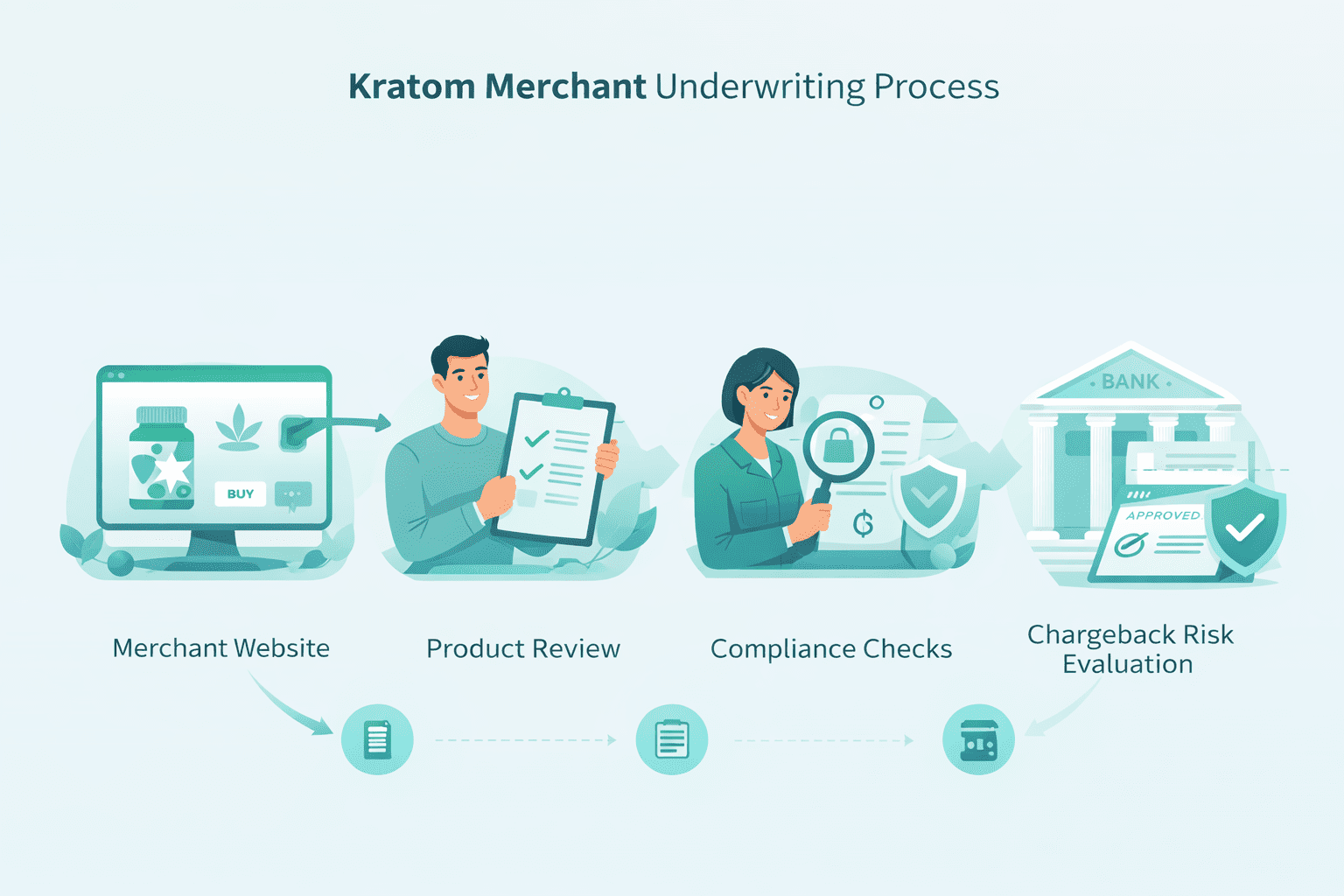
- Business verification — ownership structure, entity formation, and banking information
- Product review — powders, capsules, extracts, and 7-hydroxymitragynine exposure
- Website compliance audit — claims language, policy pages, and checkout disclosures
- Financial review — projected volume, average order value, and prior processing history
- Chargeback risk evaluation — historical dispute ratios and fraud controls
| Standard E-Commerce Underwriting | Kratom Merchant Underwriting |
|---|---|
| Basic entity verification | Enhanced product, compliance, and monitoring review |
| Limited website inspection | Full site crawl for claims and compliance risks |
| Minimal shipping scrutiny | Strict geographic restriction enforcement |
| Minimal product documentation | COAs, supplier transparency, and testing verification |
| Standard dispute monitoring | Tighter monitoring thresholds and reserves |
Why Kratom Is Classified as High Risk
Regulatory Fragmentation
Kratom laws vary widely between jurisdictions. Some states restrict or prohibit sales while others apply labeling and testing rules through versions of the Kratom Consumer Protection Act (KCPA). The American Kratom Association (AKA) has promoted these frameworks to standardize consumer protections.
Merchants improving compliance should review our guide to kratom payment compliance.
Claims and FDA Sensitivity
The FDA has repeatedly challenged kratom marketing claims. Banks monitor website language closely because medical claims can increase regulatory risk.
Dispute Exposure
Kratom merchants often experience elevated disputes due to shipping issues, product misunderstandings, or refund disagreements.
Merchants managing dispute risk should review kratom chargebacks.
Product Variance
Plain leaf powder and capsules generally underwrite more easily than concentrated extracts or products emphasizing 7-hydroxymitragynine (7-OH). Some alkaloid-focused products require stronger reserves or different acquiring banks.
Banks do not underwrite categories. They underwrite risk behavior inside categories.
The Kratom Merchant Account Underwriting Process
Business Verification
Underwriters verify entity documents, beneficial ownership, and bank account structure.
Product Review
Catalogs are reviewed for powders, capsules, extracts, and enhanced products.
Website Compliance Audit
Underwriters crawl product pages, blog posts, testimonials, and policy pages to detect risky claims.
Financial Review
Banks evaluate volume projections, average ticket size, and prior processing performance.
Monitoring Risk Assessment
Many programs place kratom merchants under high-risk ecommerce classifications such as MCC 5969 (Direct Marketing – Other).
Some poorly structured offshore programs attempt to board kratom merchants under codes such as MCC 5912 (Drug Stores / Pharmacies). When the catalog does not match the classification, this can create red flags during network monitoring.
The exact MCC matters less than what it signals: kratom is almost always treated as a monitored high-risk ecommerce category.
How Chargebacks Impact Kratom Approval
Chargebacks are one of the strongest signals banks monitor.
Most banks want dispute ratios well below 1%, with heightened concern beginning around roughly 0.75%.
- rolling reserves
- volume caps
- manual transaction monitoring
- processor reviews
- account termination
Chargebacks do not just measure dissatisfaction. They forecast underwriting risk.
Documents Banks Require from Kratom Merchants
- business formation documents
- EIN verification
- owner identification
- business bank account verification
- product catalog
- supplier invoices
- Certificates of Analysis (COAs)
- website policy pages
- prior processing statements
How Merchants Can Improve Approval Odds
- remove medical claims
- organize COAs and supplier documentation
- publish clear policies
- enforce geographic shipping restrictions
- implement age verification
- monitor disputes regularly
- be transparent about past processing history
Transparency beats cleverness in high-risk underwriting.
Field Notes: Organized underwriting packets often move significantly faster through review. Merchants providing structured documentation, COAs, and policy pages can sometimes receive decisions within a week.
Common Mistakes Merchants Make
- assuming legality guarantees approval
- cleaning up only checkout pages
- hiding extracts or enhanced SKUs
- submitting applications everywhere after a decline
- treating shutdowns as random events
When a Broker Improves Kratom Merchant Account Approval
VERIFIED operates as a multi-bank high-risk broker that evaluates merchant risk profiles before submitting underwriting files to compatible acquiring banks.
- multi-bank placement
- pre-underwriting file review
- website compliance guidance
- documentation preparation
- long-term stability planning
If your goal is durable approval rather than another shutdown, request a pre-underwriting review before applying blindly.
Further Reading
Frequently Asked Questions
What are kratom underwriting guidelines?
Kratom underwriting guidelines are the risk standards banks use to determine whether a kratom merchant can be approved for payment processing and maintain stable card acceptance.
Why do banks consider kratom high risk?
Banks consider kratom high risk due to regulatory uncertainty, dispute exposure, marketing claim risks, and reputational concerns.
What chargeback rate is acceptable for kratom merchants?
Most banks expect kratom merchants to maintain dispute ratios below 1%, with increased monitoring often starting near 0.75%.
What documents are needed for kratom merchant account approval?
Typical documents include business formation records, EIN verification, owner ID, product catalogs, supplier invoices, COAs, and processing history.
Do kratom extracts or 7-OH products affect underwriting?
Yes. Concentrated extracts and products emphasizing 7-hydroxymitragynine may require stronger reserves or placement with specialized banks.
How does VERIFIED help kratom merchants get approved?
VERIFIED reviews merchant risk profiles and matches businesses with compatible acquiring banks to improve approval stability.


Let us discover your best options.
Either submit the form below or get in touch with an agent now (415) 835-4135.
Applying is risk-free; we send your details to underwriters to find the best fit and contact you with the best option or request more details, with no credit checks or commitments.